Saturday, December 31, 2011
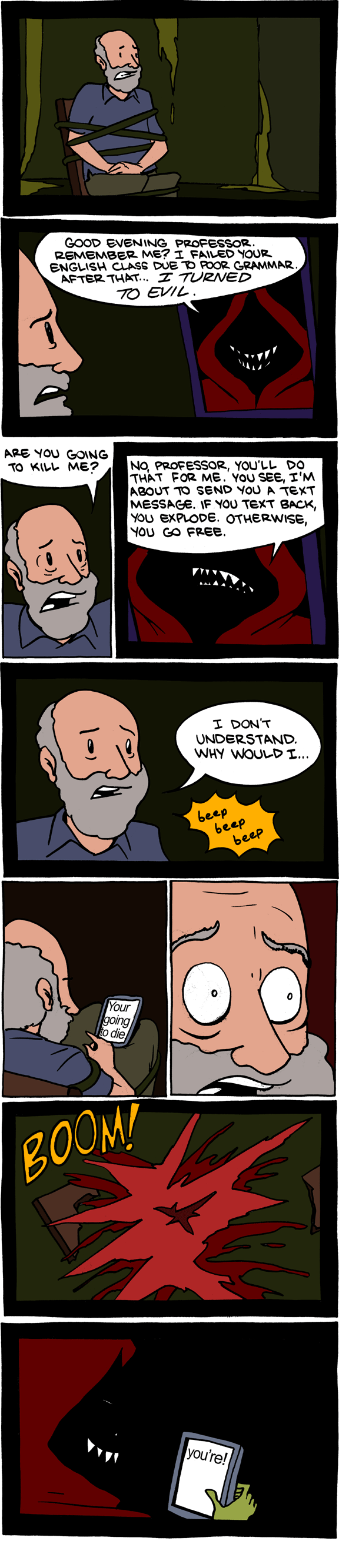
Oh! This is So Evil
What a nefarious scheme. One that could not fail.
 http://www.smbc-comics.com/comics/20111231.gif

Monday, December 5, 2011
Mirrors
Mirrors are odd things. They're how we see ourselves, but it's a reversed seeing. Yet they're perhaps the most common way we know to visualize ourselves.
If I tell myself to touch the right side of my face, my hand goes up to touch my cheek. No problem. But looking in a mirror, touching the right side of my mirror-face, the hand wants to cross over.
It's as if my image were another person; that would be their right side. So what I see in the mirror is a perceptual mix of myself and an imagined 'other person' looking at me.
We see bits and pieces of ourselves in mirrors. I can brush my teeth before a mirror and come away with no idea whether or not my hair is tidy. I can see what I want to see to some degree. It becomes trickery to allow myself to see my image without that filter.
Such an odd thing to see yourself in a mirror unexpectedly. For a sharp moment you see a stranger. For an instant, you see yourself as others see you. Then the filters kick in and you see you.
Such honesty can be hard to bear, either from mirrors or from other people.
People are mirrors for one another. We mimic words and gestures of those we get close to, even of strangers. We are influenced by the moods written in their faces, their gestures, their voices.
We see how other people act. If we admire it, we want to take it in and reflect it back from ourselves. Smiling makes us feel happier. Acting strong changes our hormones and makes us strong. We can make ourselves to be more as we wish to be. Mirroring others is part of that process.
Friends reveal so much of who you are. Who are they when they're with you? Long term relationships can become reflections of reflections, both of you mirroring long-past conceptions or stages with perhaps no validity in the present. Habits. If you disrupt the reflections you fragment the relationship.
This can be good. It lets you both see one another as who you are, not who you are in your interpreted reflections of one another. But it can also mean that instead of a friend you see a stranger, and all you share now are those long-established mutually reflecting images.
A friend who reflects you truly – why does that happen? It can be hard to bear, to have to be honest with them and with yourself. It is also liberating. If they're still around after that honesty, they truly are a friend.
Friendship. Seeing another person for who they are, not who you want / need them to be. Taking what is weak or unkind in them and holding it in gentle hands, helping them accept and improve that part of themselves. Recognizing what is noble and wise in them and honoring that, taking it into yourself and giving it back to them with humility and gratitude. Giving them the joy of loving them for all those facets, not just for the few you like best.
Letting them love who you are, too.
Wednesday, November 30, 2011
A Book's Nightmare
Authors long for 'the movie deal', but how many are pleased with the results?
 http://zs1.smbc-comics.com/comics/20111130.gif

Saturday, November 12, 2011
Alan Garner on Alan Turing
Since I first learned of Alan Turing I have been outraged at what was done to him. A comfortable outrage, I now realize. Intellectual. From a safe distance.
No longer.
A blow to the stomach -- a shock wave shattering my complacent sanctimony into bitter fragments of self-understanding and horror.
Alan Garner's simple, short biographical statement does more to show evil in the guise of morality than any epistle or sermon ever could.
This is what writing can do.
He was stocky, barrel-chested, with a high-pitched, donnish voice and the aerodynamics of a brick. He was funny and witty and he talked endlessly, but I understood very little of what he was saying, and it became clear that he ran in order to think. He seemed to be obsessed by mathematics and biology. That much I could work out.
We had one thing in common: a fascination with Disney's Snow White and the Seven Dwarfs, especially the transformation of the Wicked Queen into the Witch. He used to go over the scene in detail, dwelling on the ambiguity of the apple, red on one side, green on the other, one of which gave death. We had both been traumatised by Walt.
On one occasion he asked me whether, in my opinion as a classical linguist, artificial intelligence was possible. After a couple of miles of silence I said that, in my opinion, it was not. And that was that.
He killed himself when an ignorant and uncouth judge gave him the choice of a prison sentence or chemical castration; and I was overwhelmed by fury at the salacious, gloating humiliation imposed on my friend, and by a sense of guilt that I did not, could not, help him; which lasted for decades, and was made only worse when the Official Secrets Act revealed his true heroism.
He died of cyanide poisoning. By his body was an apple, partly eaten. The apple was not tested for cyanide. His name was Alan Turing.
http://www.guardian.co.uk/books/2011/nov/11/alan-turing-my-hero-alan-garner
No longer.
A blow to the stomach -- a shock wave shattering my complacent sanctimony into bitter fragments of self-understanding and horror.
Alan Garner's simple, short biographical statement does more to show evil in the guise of morality than any epistle or sermon ever could.
This is what writing can do.
My hero: Alan Turing, by Alan Garner
In the 1950s I was an athlete. Those were the days before joggers clogged the highway, so it was unusual for me to see another runner when I was training. We fell into the habit of meeting up and pounding the miles together for company.He was stocky, barrel-chested, with a high-pitched, donnish voice and the aerodynamics of a brick. He was funny and witty and he talked endlessly, but I understood very little of what he was saying, and it became clear that he ran in order to think. He seemed to be obsessed by mathematics and biology. That much I could work out.
We had one thing in common: a fascination with Disney's Snow White and the Seven Dwarfs, especially the transformation of the Wicked Queen into the Witch. He used to go over the scene in detail, dwelling on the ambiguity of the apple, red on one side, green on the other, one of which gave death. We had both been traumatised by Walt.
On one occasion he asked me whether, in my opinion as a classical linguist, artificial intelligence was possible. After a couple of miles of silence I said that, in my opinion, it was not. And that was that.
He killed himself when an ignorant and uncouth judge gave him the choice of a prison sentence or chemical castration; and I was overwhelmed by fury at the salacious, gloating humiliation imposed on my friend, and by a sense of guilt that I did not, could not, help him; which lasted for decades, and was made only worse when the Official Secrets Act revealed his true heroism.
He died of cyanide poisoning. By his body was an apple, partly eaten. The apple was not tested for cyanide. His name was Alan Turing.
http://www.guardian.co.uk/books/2011/nov/11/alan-turing-my-hero-alan-garner
Thursday, November 10, 2011

Thursday, November 3, 2011
How to Die?
This article is about two deaths. Two men, both artists, and how they faced early death.
One in dissolution and despair. One in awareness and creation.
Isn't this article really about how to live?
NPR's Krulwich Wonders
One in dissolution and despair. One in awareness and creation.
Isn't this article really about how to live?
NPR's Krulwich Wonders
Tuesday, November 1, 2011
Subscribe to:
Posts (Atom)