
Showing posts with label science. Show all posts
Showing posts with label science. Show all posts
Tuesday, April 17, 2012

Wednesday, March 28, 2012
Thoroughly Conscious Ignorance
"Science becomes a series of elegant puzzles and puzzles within puzzles—and who doesn’t like puzzles?"
This is absolutely right. The thrill of contemplating everything we can learn. Yes, I love to learn what is known, but it inspires me to realize that everything we learn means there's more to explore.
This is absolutely right. The thrill of contemplating everything we can learn. Yes, I love to learn what is known, but it inspires me to realize that everything we learn means there's more to explore.
Or, to quote a less 'technical' source, "The world is so full of a number of things / I'm sure we should all be as happy as kings."
From Scientific American, "What Science Wants to Know"
Monday, March 19, 2012
Saturday, January 14, 2012
Scientific Reality
If only it were so simple. This applies to writing, too. But there it's known as editing, revising, rewriting, more editing, more revising ....


Saturday, November 12, 2011
Alan Garner on Alan Turing
Since I first learned of Alan Turing I have been outraged at what was done to him. A comfortable outrage, I now realize. Intellectual. From a safe distance.
No longer.
A blow to the stomach -- a shock wave shattering my complacent sanctimony into bitter fragments of self-understanding and horror.
Alan Garner's simple, short biographical statement does more to show evil in the guise of morality than any epistle or sermon ever could.
This is what writing can do.
He was stocky, barrel-chested, with a high-pitched, donnish voice and the aerodynamics of a brick. He was funny and witty and he talked endlessly, but I understood very little of what he was saying, and it became clear that he ran in order to think. He seemed to be obsessed by mathematics and biology. That much I could work out.
We had one thing in common: a fascination with Disney's Snow White and the Seven Dwarfs, especially the transformation of the Wicked Queen into the Witch. He used to go over the scene in detail, dwelling on the ambiguity of the apple, red on one side, green on the other, one of which gave death. We had both been traumatised by Walt.
On one occasion he asked me whether, in my opinion as a classical linguist, artificial intelligence was possible. After a couple of miles of silence I said that, in my opinion, it was not. And that was that.
He killed himself when an ignorant and uncouth judge gave him the choice of a prison sentence or chemical castration; and I was overwhelmed by fury at the salacious, gloating humiliation imposed on my friend, and by a sense of guilt that I did not, could not, help him; which lasted for decades, and was made only worse when the Official Secrets Act revealed his true heroism.
He died of cyanide poisoning. By his body was an apple, partly eaten. The apple was not tested for cyanide. His name was Alan Turing.
http://www.guardian.co.uk/books/2011/nov/11/alan-turing-my-hero-alan-garner
No longer.
A blow to the stomach -- a shock wave shattering my complacent sanctimony into bitter fragments of self-understanding and horror.
Alan Garner's simple, short biographical statement does more to show evil in the guise of morality than any epistle or sermon ever could.
This is what writing can do.
My hero: Alan Turing, by Alan Garner
In the 1950s I was an athlete. Those were the days before joggers clogged the highway, so it was unusual for me to see another runner when I was training. We fell into the habit of meeting up and pounding the miles together for company.He was stocky, barrel-chested, with a high-pitched, donnish voice and the aerodynamics of a brick. He was funny and witty and he talked endlessly, but I understood very little of what he was saying, and it became clear that he ran in order to think. He seemed to be obsessed by mathematics and biology. That much I could work out.
We had one thing in common: a fascination with Disney's Snow White and the Seven Dwarfs, especially the transformation of the Wicked Queen into the Witch. He used to go over the scene in detail, dwelling on the ambiguity of the apple, red on one side, green on the other, one of which gave death. We had both been traumatised by Walt.
On one occasion he asked me whether, in my opinion as a classical linguist, artificial intelligence was possible. After a couple of miles of silence I said that, in my opinion, it was not. And that was that.
He killed himself when an ignorant and uncouth judge gave him the choice of a prison sentence or chemical castration; and I was overwhelmed by fury at the salacious, gloating humiliation imposed on my friend, and by a sense of guilt that I did not, could not, help him; which lasted for decades, and was made only worse when the Official Secrets Act revealed his true heroism.
He died of cyanide poisoning. By his body was an apple, partly eaten. The apple was not tested for cyanide. His name was Alan Turing.
http://www.guardian.co.uk/books/2011/nov/11/alan-turing-my-hero-alan-garner
Tuesday, October 25, 2011
Anoesis: How New Words Open New Worlds
Yesterday morning I learned a new word. Such a delight (thanks to word of the day). There are words that I feel the lack of. One is a word for the deliberate act of ignoring. If I say ignorance, (IG-nor-ance) it means I don't know. But I want a word for ig-NOR-ance. Humans are very good at deliberately ignoring things, so why is there no word for it?
Yesterday's treasure was Anoesis: being flooded with emotion or sensation, and unable to form rational thought about it. And the most peculiar thing happened. That afternoon I was plunged into anoesis.
I love to analyze, and having a label for that abstract, overwhelming, compelling state helped. Of course, I was trying to find a way to express this state of being so I could use it in a novel, but also to help me understand why I felt that way.
Like the apparent duality in physics, I live in a Newtonian world. My still-enduring moment of anoesis plunged me into a Quantum universe where all I know and think is altered, pulsing to different energies and perceptions. The quantum universe underlies all I think I know. I, too, am looking for a grand unification of what I am and what I seem to be.
Words are not dangerous things, but they do foment revolutions, personal or global.
Yesterday's treasure was Anoesis: being flooded with emotion or sensation, and unable to form rational thought about it. And the most peculiar thing happened. That afternoon I was plunged into anoesis.
I love to analyze, and having a label for that abstract, overwhelming, compelling state helped. Of course, I was trying to find a way to express this state of being so I could use it in a novel, but also to help me understand why I felt that way.
Like the apparent duality in physics, I live in a Newtonian world. My still-enduring moment of anoesis plunged me into a Quantum universe where all I know and think is altered, pulsing to different energies and perceptions. The quantum universe underlies all I think I know. I, too, am looking for a grand unification of what I am and what I seem to be.
Words are not dangerous things, but they do foment revolutions, personal or global.
Sunday, October 23, 2011
Anti-Intellectual Incompetence
An interesting post from Massimo Pigliucci at Rationally Speaking.
I was particularly intrigued because I had just read yet another 'discussion' on religion vs. science, where the arguers for religion were chronically unable to discern the difference between proof and belief. If one cannot make that very gaping distinction, there is no hope of discussion. I admit to feeling there is no need for discussion. Religion, in this so global modern world, should be private and personal, and ought not to be imposed on others. My beliefs are mine; theirs are theirs. But provable information -- that is the realm of the public domain.
This article discusses another false dichotomy: intellectualism vs engineers. Timothy Ferris of 'Wired Magazine' argues that only productive technology is worthwhile (does he work for Perry?) and that thinking, ideas, and intellectual processes are a waste of time.
How, I wonder, did he get the education that allowed him to think about this? Not that he did much thinking. It is clear he is bias-promotion rather than genuine reasoning in his article.
Massimo makes several good points, most notably that Ferris "makes his case by cherry picking examples, distorting history, and simply ignoring what is not convenient for his thesis." He provides examples to support this claim.
Later, Massimo says, "five minute of serious reflection should have made Ferris realize that he created a straw man with precious little correspondence to reality." Again, he offers counter arguments worth considering.
I am, as with religion vs science, willing to allow both sides validity. I see them as reflecting different aspects of human nature and need. I have always been grossly suspicious of any premise that requires absolute exclusive validity. Nature vs Nurture. Particle vs Wave. Life is seldom so clear cut. My guiding principle is 'it's a spectrum' and from that beginning, I proceed, cautiously, to determine how dark or light the shades of grey are on any issue.
Well worth reading: http://rationallyspeaking.blogspot.com/2011/10/engineers-vs-intellectuals-how-timothy.html
I was particularly intrigued because I had just read yet another 'discussion' on religion vs. science, where the arguers for religion were chronically unable to discern the difference between proof and belief. If one cannot make that very gaping distinction, there is no hope of discussion. I admit to feeling there is no need for discussion. Religion, in this so global modern world, should be private and personal, and ought not to be imposed on others. My beliefs are mine; theirs are theirs. But provable information -- that is the realm of the public domain.
This article discusses another false dichotomy: intellectualism vs engineers. Timothy Ferris of 'Wired Magazine' argues that only productive technology is worthwhile (does he work for Perry?) and that thinking, ideas, and intellectual processes are a waste of time.
How, I wonder, did he get the education that allowed him to think about this? Not that he did much thinking. It is clear he is bias-promotion rather than genuine reasoning in his article.
Massimo makes several good points, most notably that Ferris "makes his case by cherry picking examples, distorting history, and simply ignoring what is not convenient for his thesis." He provides examples to support this claim.
Later, Massimo says, "five minute of serious reflection should have made Ferris realize that he created a straw man with precious little correspondence to reality." Again, he offers counter arguments worth considering.
I am, as with religion vs science, willing to allow both sides validity. I see them as reflecting different aspects of human nature and need. I have always been grossly suspicious of any premise that requires absolute exclusive validity. Nature vs Nurture. Particle vs Wave. Life is seldom so clear cut. My guiding principle is 'it's a spectrum' and from that beginning, I proceed, cautiously, to determine how dark or light the shades of grey are on any issue.
Well worth reading: http://rationallyspeaking.blogspot.com/2011/10/engineers-vs-intellectuals-how-timothy.html
Saturday, September 24, 2011
Writing, Bacteria, Evolution, and Rules
I wasn't sure which blog to post this article to. It is science, yes, but it is also philosophy, and very little thought was required to turn that philosophy into writing advice. So, writing, philosophy, and science? Sounds like it belongs right here.
How Life Arose on Earth, and How a Singularity Might Bring It Down
September 23, 2011
The origins of life; the process of evolution; the dangers of too rapid growth, but also of stagnation.
Can you see the application to writing?
There is a quote early on, from Sean Carroll. He blogs at Cosmic Variance.
“The purpose of life,” meeting co-organizer and Caltech cosmologist Sean Carroll said in his opening remarks, “is to hydrogenate carbon dioxide.”
Well, that's a downer for all of us who want to believe there's something inherently unique and purposeful about humanity. But as a writer, I see that as a call to remember the true purpose of my work: to write stories.
Writers are not marketing machines; we are not role-models; we are not advocates for this, that, or anything. Of course, these are aspects of our work, but they are tangential, not essential to what we do. Writers tell stories. In non-fiction, writers provide information.
That's it. That is our whole reason to be. To write. Anything else is the proverbial icing on the cake. Don't get so caught up in the add-ons that you lose sight of your true purpose. Just tell stories.
Back to the article. Inorganic reactions become biological reactions.The evolution of life-forms was driven by the spontaneous generation of complexity.
In writing, we start with a few tools. Words. Sentences. Grammar. Themes that determine how we arrange those elements. Then we reach a critical level, and the ideas take over, dictating the words, forcing the patterns into new lines.
Some people say their characters take over the story and they can no longer tell them what to do. Such willfulness is analogous to the emergence of biological reactions in evolution. What these writers are saying is that the story has found its life. It has evolved from connected words to an entity with a need to grow and develop.
Just as there are millions upon millions of life forms in the past, present, and future of our world, so too are there millions of stories. Like life, they rely on a few basic structures, but also like life, the pressures of their environment, the resources they have, the stimuli they perceive will alter and adapt them in to myriad forms.
Nothing new under the sun? Quite correct. It is not new, it is the history of life and of literature to constantly create new permutations, new adaptations. Infinite variety.
The article goes on to discuss how a strain of bacterium discovered they could use the citrate in their agar, rather than depend upon the glucose. This evolutionary adaptation proved repeatable. (I loved the comment, "Sympathetic murmurs of pity for the grad students spread through the FQXi audience." Grad students do all the long, tedious slog-work essential for science) It's not just making stuff up, folks. It's an incredible amount of painstaking, repetitious labor that leads to science. That's why we don't call it science unless it can be proven and repeated. Not at all the same thing as merely wanting it to be true.
In writing, the old patterns work. We are taught how to craft a sentence, how to develop a character, how to 'show-don't-tell.' But if we read, we discover that the greatest writers break the rules and enhance, even throw out the accepted forms. They bring new ways of telling stories into the world. Innovation drives literature as surely as it drives life.
Many, perhaps most innovations will fail. But a few succeed. Don't be afraid to try new styles, new characters. Never let yourself fall into believing that there's a one-and-only way to write. That said, like the bacteria in the experiment, there's a reason why we are taught rules. They work. If you innovate, you may fail. Be warned.
The end of the article discusses how different systems follow similar patterns. Bacteria, cities, humanity: all follow predictable relations. Smaller organisms have faster metabolisms. People in cities walk faster. And short stories require tighter, more urgent pacing.
Complexity theorist. Now there's a job title I'd love to have. "Complexity theorist Raissa D’Souza of U.C. Davis argued in her talk that when you have coupled complex systems, any break in the growth trends tends to be accompanied by wild fluctuations. Modern society is predicated on growth; stability is tantamount to collapse."
I've long wondered why humans in western cultures are so obsessed with growth. The town I live in, a delightful, charming place, is being destroyed by growth. The university is being mutated into a cancer that absorbs and destroys the quality of life for the campus and the town. But it will be a Big University, and that is, alas, all that matters.
Snarking aside, being big is not, by default, better. Books are too often too long. Don't be afraid to cut. Remove whole scenes. The joy of computer-aided writing is that you can copy out the entire novel in a blink, tear it to shreds, rearrange the bits, keep what works, paste that into a new version, and delete the rest.
Do hire an editor. They aren't enamored with your words, only with the finished product. They have the objectivity to see what is extraneous where you can't bear to let anything go. Trust your editor!
The final advice of the article is one all writers hear frequently. Get off the internet.
Time, lots of time, gave us life on earth. Even more sweeps of time gave us our selves. What's a few months to give life to your words?
How Life Arose on Earth, and How a Singularity Might Bring It Down
September 23, 2011
The origins of life; the process of evolution; the dangers of too rapid growth, but also of stagnation.
Can you see the application to writing?
There is a quote early on, from Sean Carroll. He blogs at Cosmic Variance.
“The purpose of life,” meeting co-organizer and Caltech cosmologist Sean Carroll said in his opening remarks, “is to hydrogenate carbon dioxide.”
Well, that's a downer for all of us who want to believe there's something inherently unique and purposeful about humanity. But as a writer, I see that as a call to remember the true purpose of my work: to write stories.
Writers are not marketing machines; we are not role-models; we are not advocates for this, that, or anything. Of course, these are aspects of our work, but they are tangential, not essential to what we do. Writers tell stories. In non-fiction, writers provide information.
That's it. That is our whole reason to be. To write. Anything else is the proverbial icing on the cake. Don't get so caught up in the add-ons that you lose sight of your true purpose. Just tell stories.
Back to the article. Inorganic reactions become biological reactions.The evolution of life-forms was driven by the spontaneous generation of complexity.
In writing, we start with a few tools. Words. Sentences. Grammar. Themes that determine how we arrange those elements. Then we reach a critical level, and the ideas take over, dictating the words, forcing the patterns into new lines.
Some people say their characters take over the story and they can no longer tell them what to do. Such willfulness is analogous to the emergence of biological reactions in evolution. What these writers are saying is that the story has found its life. It has evolved from connected words to an entity with a need to grow and develop.
Just as there are millions upon millions of life forms in the past, present, and future of our world, so too are there millions of stories. Like life, they rely on a few basic structures, but also like life, the pressures of their environment, the resources they have, the stimuli they perceive will alter and adapt them in to myriad forms.
Nothing new under the sun? Quite correct. It is not new, it is the history of life and of literature to constantly create new permutations, new adaptations. Infinite variety.
The article goes on to discuss how a strain of bacterium discovered they could use the citrate in their agar, rather than depend upon the glucose. This evolutionary adaptation proved repeatable. (I loved the comment, "Sympathetic murmurs of pity for the grad students spread through the FQXi audience." Grad students do all the long, tedious slog-work essential for science) It's not just making stuff up, folks. It's an incredible amount of painstaking, repetitious labor that leads to science. That's why we don't call it science unless it can be proven and repeated. Not at all the same thing as merely wanting it to be true.
In writing, the old patterns work. We are taught how to craft a sentence, how to develop a character, how to 'show-don't-tell.' But if we read, we discover that the greatest writers break the rules and enhance, even throw out the accepted forms. They bring new ways of telling stories into the world. Innovation drives literature as surely as it drives life.
Many, perhaps most innovations will fail. But a few succeed. Don't be afraid to try new styles, new characters. Never let yourself fall into believing that there's a one-and-only way to write. That said, like the bacteria in the experiment, there's a reason why we are taught rules. They work. If you innovate, you may fail. Be warned.
The end of the article discusses how different systems follow similar patterns. Bacteria, cities, humanity: all follow predictable relations. Smaller organisms have faster metabolisms. People in cities walk faster. And short stories require tighter, more urgent pacing.
Complexity theorist. Now there's a job title I'd love to have. "Complexity theorist Raissa D’Souza of U.C. Davis argued in her talk that when you have coupled complex systems, any break in the growth trends tends to be accompanied by wild fluctuations. Modern society is predicated on growth; stability is tantamount to collapse."
I've long wondered why humans in western cultures are so obsessed with growth. The town I live in, a delightful, charming place, is being destroyed by growth. The university is being mutated into a cancer that absorbs and destroys the quality of life for the campus and the town. But it will be a Big University, and that is, alas, all that matters.
Snarking aside, being big is not, by default, better. Books are too often too long. Don't be afraid to cut. Remove whole scenes. The joy of computer-aided writing is that you can copy out the entire novel in a blink, tear it to shreds, rearrange the bits, keep what works, paste that into a new version, and delete the rest.
Do hire an editor. They aren't enamored with your words, only with the finished product. They have the objectivity to see what is extraneous where you can't bear to let anything go. Trust your editor!
The final advice of the article is one all writers hear frequently. Get off the internet.
Time, lots of time, gave us life on earth. Even more sweeps of time gave us our selves. What's a few months to give life to your words?
Sunday, August 28, 2011
Researching a Novel
There always comes a point where I have to cope with all the "insert here" comments. In Adjacent Possibilities, that was, and still is, working in the philosophy that is integral to the characters' world views, in a palatable form for readers.
Tonight I've been working on the chemistry aspects of the Sooty story.
Sooty is a creature from another dimension. He cannot live on the naturally occurring elements we have. His world is more like the neutron soup of our just-post-Big Bang. He needs to combine and break apart atoms to simulate the energies he's familiar with. It has to be a mix of elements, as each one has a unique 'flavour' that helps sustain him, much like the variety of nutrients we need in our bodies to function, including tiny traces of metals.
Hey, it's the distinctly science fiction aspect of the story. I classify Sooty as speculative, though, as the science is adjunct to, and not the main purpose of the tale.
Anyways, I've been reabsorbing what chemistry I knew, and much that I've forgotten, and then making my own use of it to suit my goals (apologies to real chemists). But it took many hours to get even the limited amount of factual information I required into story form.
Next is to go through for character consistency. The rereading that accompanied inserting chemistry revealed several major flaws. If Anna and Sooty manipulate her best friend, Tai's mind, I see that Anna has to tell Tai the truth eventually. How would I react if I found my best friend had controlled my thoughts? How would you?
I've got ideas jotted down, and hopefully tomorrow will get them into the story, along with other omissions.
So, mostly revising, or editing, or whatever you call it when you are sticking in the bits you avoided in the creation stage. But I have gotten two thousand more words in over the last two nights. Whee!
I will declare the first draft complete when I eliminate all the "insert here" or "expand this" notes. Of which there are far, far too many.
Tonight I've been working on the chemistry aspects of the Sooty story.
Sooty is a creature from another dimension. He cannot live on the naturally occurring elements we have. His world is more like the neutron soup of our just-post-Big Bang. He needs to combine and break apart atoms to simulate the energies he's familiar with. It has to be a mix of elements, as each one has a unique 'flavour' that helps sustain him, much like the variety of nutrients we need in our bodies to function, including tiny traces of metals.
Hey, it's the distinctly science fiction aspect of the story. I classify Sooty as speculative, though, as the science is adjunct to, and not the main purpose of the tale.
Anyways, I've been reabsorbing what chemistry I knew, and much that I've forgotten, and then making my own use of it to suit my goals (apologies to real chemists). But it took many hours to get even the limited amount of factual information I required into story form.
Next is to go through for character consistency. The rereading that accompanied inserting chemistry revealed several major flaws. If Anna and Sooty manipulate her best friend, Tai's mind, I see that Anna has to tell Tai the truth eventually. How would I react if I found my best friend had controlled my thoughts? How would you?
I've got ideas jotted down, and hopefully tomorrow will get them into the story, along with other omissions.
So, mostly revising, or editing, or whatever you call it when you are sticking in the bits you avoided in the creation stage. But I have gotten two thousand more words in over the last two nights. Whee!
I will declare the first draft complete when I eliminate all the "insert here" or "expand this" notes. Of which there are far, far too many.
Friday, August 26, 2011
Humor For Sooty (and Chemistry)
Gotta love these. Lolcats has been running a series of Chemistry Cat jokes, and now Saturday Morning Breakfast Cereal gets in on the act.
Chemistry is part of Sooty's story, you see. Again, I find synchronicity. When I work on Adjacent Possibilities, the world is full of philosophy, and when I work on Sooty, chemistry.
Of course, I know it's only that I notice these things because I'm thinking about them, but even that is good. It means I'm seeing things I wouldn't have noticed before.
Wonderful!

(sorry about the overlap, but using a smaller size-option made this one unreadable)
Chemistry is part of Sooty's story, you see. Again, I find synchronicity. When I work on Adjacent Possibilities, the world is full of philosophy, and when I work on Sooty, chemistry.
Of course, I know it's only that I notice these things because I'm thinking about them, but even that is good. It means I'm seeing things I wouldn't have noticed before.
Wonderful!

(sorry about the overlap, but using a smaller size-option made this one unreadable)
Update 23 Oct, 2011 I was just going over old posts and saw this image had vanished. I can't get it to reload, so here's the direct link to the comic from its site's archives:
http://www.smbc-comics.com/index.php?db=comics&id=2349
Friday, July 29, 2011
The New Novel: Working Title 'Sooty'
Sooty is a character in the novel. It is a non-earth entity that enters Anna's life at a time when her world is already in upheaval, and sends it into chaos. With humor, of course. I don't like to write depressing stories.
He requires unusual forms of nutrition, including elements that he transforms to suit his nature. One of Anna's challenges in the book is to find sources for these elements.
I was delighted to get these sites today: Visions: Rare and Precious and the Dynamic Periodic Table. Thanks to GrrlScientist for the table via her wonderful series on the elements. I look forward to each week's element.
He requires unusual forms of nutrition, including elements that he transforms to suit his nature. One of Anna's challenges in the book is to find sources for these elements.
I was delighted to get these sites today: Visions: Rare and Precious and the Dynamic Periodic Table. Thanks to GrrlScientist for the table via her wonderful series on the elements. I look forward to each week's element.
Friday, July 15, 2011
Rethinking Argument
We tend to make up our minds for emotional reasons. Then we identify with our conclusions, and find ourselves threatened or angry when someone tries to alter our conclusions. The more comfort we derive from our belief-based conclusion, the more fiercely we resist someone trying to change it.
Hence all the hostility amongst religions, or competing scientific theories.
We should be, at the very least, polite in our arguments -- and always have good, solid supporting evidence.
For politeness: How to Argue on the Internet and Linguistic Politeness Research Group
For good, solid arguments :

http://www.smbc-comics.com/
Hence all the hostility amongst religions, or competing scientific theories.
We should be, at the very least, polite in our arguments -- and always have good, solid supporting evidence.
For politeness: How to Argue on the Internet and Linguistic Politeness Research Group
For good, solid arguments :
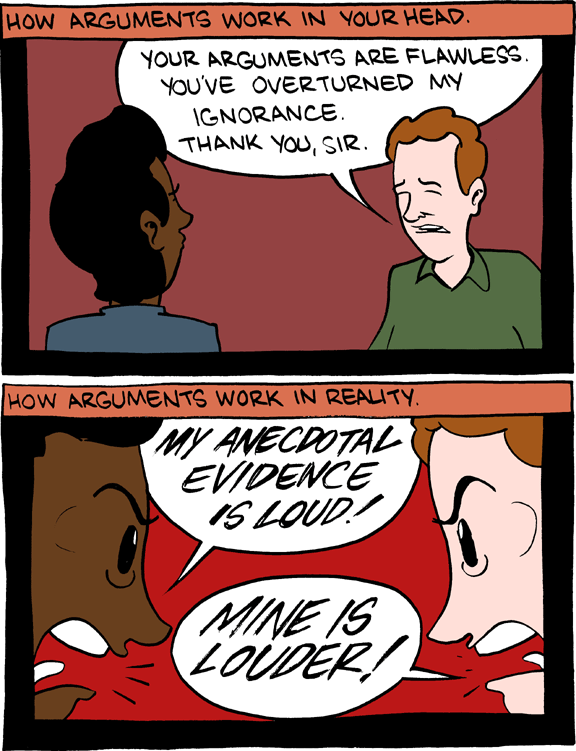
http://www.smbc-comics.com/
Thursday, June 2, 2011
Science and Uncertainty
Four posts today, all on the topics of what we think we know, what we actually do know, and how we go about distinguishing between the two. And having distinguished, what do we do about it?
First up, recognizing that uncertainty is not an excuse for ignoring probable danger. The context here is global climate change. There is enough evidence to know that the climate is warming. Even if it were entirely natural, we still need to be working hard on ways to minimize the disruption (gentle word) climate shift will cause. And yet the reaction is all too often complete denial (humorous take on argumentative reasoning here) or accepting it's happening, but not that it will cause problems. Neither response will help. Hence the phrase in Professor Juan Cole's post: "The Big Oil and Big Coal executives attempting to stop efforts to reduce emissions are thus in effect mass murderers of a future generation."
Read also Chris Mooney on uncertainty as a response.
Then there was a delightful post about established beliefs in science. Eventually testing wins over belief. That's why science improves the way we live and belief can't. Without science, we'd all be living in caves eating raw food and dying of simple injuries and diseases. But we'd have our beliefs! Such a comfort. The first hand account by Mpemba is a joy to read. And I loved footnote six. Finding observational information in all sorts of strange places.
Last is a distressing post about how we alter our own behavior to fit perceived stereotypes about ourselves. Apparently the ruling bodies of the Educational Testing Services want to keep women and minorities out of higher education? (don't sue me - change your testing!)
First up, recognizing that uncertainty is not an excuse for ignoring probable danger. The context here is global climate change. There is enough evidence to know that the climate is warming. Even if it were entirely natural, we still need to be working hard on ways to minimize the disruption (gentle word) climate shift will cause. And yet the reaction is all too often complete denial (humorous take on argumentative reasoning here) or accepting it's happening, but not that it will cause problems. Neither response will help. Hence the phrase in Professor Juan Cole's post: "The Big Oil and Big Coal executives attempting to stop efforts to reduce emissions are thus in effect mass murderers of a future generation."
Read also Chris Mooney on uncertainty as a response.
Then there was a delightful post about established beliefs in science. Eventually testing wins over belief. That's why science improves the way we live and belief can't. Without science, we'd all be living in caves eating raw food and dying of simple injuries and diseases. But we'd have our beliefs! Such a comfort. The first hand account by Mpemba is a joy to read. And I loved footnote six. Finding observational information in all sorts of strange places.
Last is a distressing post about how we alter our own behavior to fit perceived stereotypes about ourselves. Apparently the ruling bodies of the Educational Testing Services want to keep women and minorities out of higher education? (don't sue me - change your testing!)
Subscribe to:
Posts (Atom)