
Showing posts with label Writing. Show all posts
Showing posts with label Writing. Show all posts
Saturday, January 14, 2012
Scientific Reality
If only it were so simple. This applies to writing, too. But there it's known as editing, revising, rewriting, more editing, more revising ....


Saturday, December 31, 2011
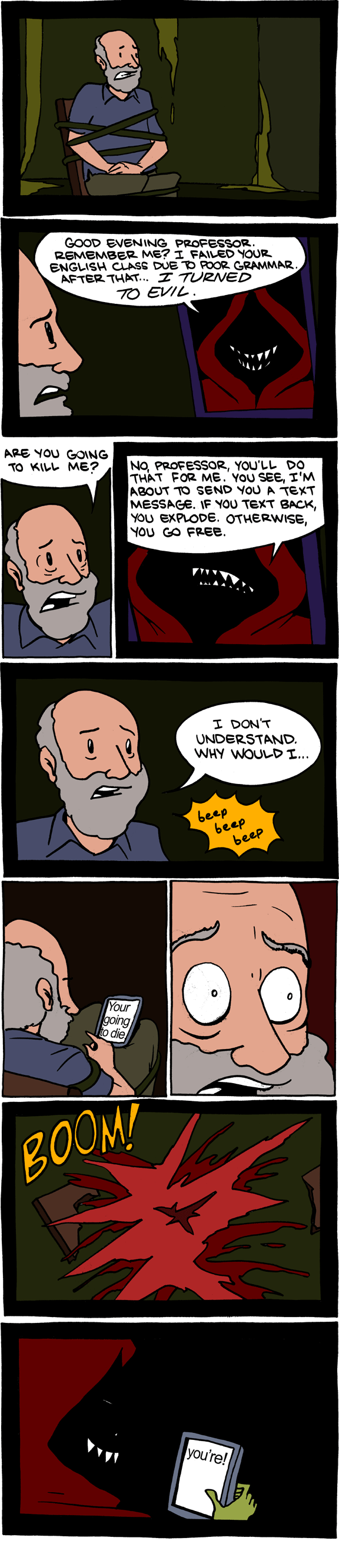
Oh! This is So Evil
What a nefarious scheme. One that could not fail.
 http://www.smbc-comics.com/comics/20111231.gif
Wednesday, November 30, 2011
A Book's Nightmare
Authors long for 'the movie deal', but how many are pleased with the results?
 http://zs1.smbc-comics.com/comics/20111130.gif

Saturday, November 12, 2011
Alan Garner on Alan Turing
Since I first learned of Alan Turing I have been outraged at what was done to him. A comfortable outrage, I now realize. Intellectual. From a safe distance.
No longer.
A blow to the stomach -- a shock wave shattering my complacent sanctimony into bitter fragments of self-understanding and horror.
Alan Garner's simple, short biographical statement does more to show evil in the guise of morality than any epistle or sermon ever could.
This is what writing can do.
He was stocky, barrel-chested, with a high-pitched, donnish voice and the aerodynamics of a brick. He was funny and witty and he talked endlessly, but I understood very little of what he was saying, and it became clear that he ran in order to think. He seemed to be obsessed by mathematics and biology. That much I could work out.
We had one thing in common: a fascination with Disney's Snow White and the Seven Dwarfs, especially the transformation of the Wicked Queen into the Witch. He used to go over the scene in detail, dwelling on the ambiguity of the apple, red on one side, green on the other, one of which gave death. We had both been traumatised by Walt.
On one occasion he asked me whether, in my opinion as a classical linguist, artificial intelligence was possible. After a couple of miles of silence I said that, in my opinion, it was not. And that was that.
He killed himself when an ignorant and uncouth judge gave him the choice of a prison sentence or chemical castration; and I was overwhelmed by fury at the salacious, gloating humiliation imposed on my friend, and by a sense of guilt that I did not, could not, help him; which lasted for decades, and was made only worse when the Official Secrets Act revealed his true heroism.
He died of cyanide poisoning. By his body was an apple, partly eaten. The apple was not tested for cyanide. His name was Alan Turing.
http://www.guardian.co.uk/books/2011/nov/11/alan-turing-my-hero-alan-garner
No longer.
A blow to the stomach -- a shock wave shattering my complacent sanctimony into bitter fragments of self-understanding and horror.
Alan Garner's simple, short biographical statement does more to show evil in the guise of morality than any epistle or sermon ever could.
This is what writing can do.
My hero: Alan Turing, by Alan Garner
In the 1950s I was an athlete. Those were the days before joggers clogged the highway, so it was unusual for me to see another runner when I was training. We fell into the habit of meeting up and pounding the miles together for company.He was stocky, barrel-chested, with a high-pitched, donnish voice and the aerodynamics of a brick. He was funny and witty and he talked endlessly, but I understood very little of what he was saying, and it became clear that he ran in order to think. He seemed to be obsessed by mathematics and biology. That much I could work out.
We had one thing in common: a fascination with Disney's Snow White and the Seven Dwarfs, especially the transformation of the Wicked Queen into the Witch. He used to go over the scene in detail, dwelling on the ambiguity of the apple, red on one side, green on the other, one of which gave death. We had both been traumatised by Walt.
On one occasion he asked me whether, in my opinion as a classical linguist, artificial intelligence was possible. After a couple of miles of silence I said that, in my opinion, it was not. And that was that.
He killed himself when an ignorant and uncouth judge gave him the choice of a prison sentence or chemical castration; and I was overwhelmed by fury at the salacious, gloating humiliation imposed on my friend, and by a sense of guilt that I did not, could not, help him; which lasted for decades, and was made only worse when the Official Secrets Act revealed his true heroism.
He died of cyanide poisoning. By his body was an apple, partly eaten. The apple was not tested for cyanide. His name was Alan Turing.
http://www.guardian.co.uk/books/2011/nov/11/alan-turing-my-hero-alan-garner
Thursday, November 10, 2011

Saturday, October 29, 2011
I know I'm a Writer Because ....
I've read the quotes. 'unhappy is the house where a writer lives' sorts of things. I don't know about unhappy, but a writer does live here.
I am not a person who writes. I am a writer.
I know this because my deepest, most soul-stirring or harrowing emotions are greeted with a rapturous: "Oh cool! Now if I can just get this into words, I can use it in a story!"
I am not a person who writes. I am a writer.
I know this because my deepest, most soul-stirring or harrowing emotions are greeted with a rapturous: "Oh cool! Now if I can just get this into words, I can use it in a story!"
Tuesday, October 25, 2011
Anoesis: How New Words Open New Worlds
Yesterday morning I learned a new word. Such a delight (thanks to word of the day). There are words that I feel the lack of. One is a word for the deliberate act of ignoring. If I say ignorance, (IG-nor-ance) it means I don't know. But I want a word for ig-NOR-ance. Humans are very good at deliberately ignoring things, so why is there no word for it?
Yesterday's treasure was Anoesis: being flooded with emotion or sensation, and unable to form rational thought about it. And the most peculiar thing happened. That afternoon I was plunged into anoesis.
I love to analyze, and having a label for that abstract, overwhelming, compelling state helped. Of course, I was trying to find a way to express this state of being so I could use it in a novel, but also to help me understand why I felt that way.
Like the apparent duality in physics, I live in a Newtonian world. My still-enduring moment of anoesis plunged me into a Quantum universe where all I know and think is altered, pulsing to different energies and perceptions. The quantum universe underlies all I think I know. I, too, am looking for a grand unification of what I am and what I seem to be.
Words are not dangerous things, but they do foment revolutions, personal or global.
Yesterday's treasure was Anoesis: being flooded with emotion or sensation, and unable to form rational thought about it. And the most peculiar thing happened. That afternoon I was plunged into anoesis.
I love to analyze, and having a label for that abstract, overwhelming, compelling state helped. Of course, I was trying to find a way to express this state of being so I could use it in a novel, but also to help me understand why I felt that way.
Like the apparent duality in physics, I live in a Newtonian world. My still-enduring moment of anoesis plunged me into a Quantum universe where all I know and think is altered, pulsing to different energies and perceptions. The quantum universe underlies all I think I know. I, too, am looking for a grand unification of what I am and what I seem to be.
Words are not dangerous things, but they do foment revolutions, personal or global.
Sunday, October 2, 2011
Pitch Puzzles -or- Jane Austen in Twenty-Five Words
I read about a pitch opportunity on the blog Help! I need a Publisher.
Twenty-five words to hook a reader onto your story. Not at all easy. I wonder if it helps if one's story is dramatic as opposed to thoughtful? Certainly some of the pitches in the comments were catchy -- well written, but also full of interesting premises and exciting events.
So what if you're writing about normal people living normal lives in normal ways, with no supernatural beings, no murders, no abusive family-members: then what?
I started wondering, how would I pitch Jane Austen -- any Jane Austen, in twenty-five words?
Feisty young woman tangles with arrogant man. Both mature, and despite family upheavals and conflicts, romance follows.
Quiet woman finds lost love again, but has he forgiven her past rejection? Family conflicts, scheming plots, but steadfast love wins all.
Two sisters exemplify reason and emotion, and both learn that a balance between the two is the key to love and life.
Okay -- I've gotten a bit silly. Sorry. In order, they were 'Pride and Prejudice', 'Persuasion', and 'Sense and Sensibility'. I didn't use my word quotas, so I could flesh them out a bit -- these ideas were off the top of my head.
The problem for me is that what sets these stories apart is not the basic plot, which sounds like a simple romance novel, but the development of the characters. "Both mature". They do. Both Elizabeth and Darcy are very different people by the end of the novel, and that is what's compelling: the people she creates and the interactions between them.
So my puzzle is, how do you pitch character development? Ideas, anyone?
Twenty-five words to hook a reader onto your story. Not at all easy. I wonder if it helps if one's story is dramatic as opposed to thoughtful? Certainly some of the pitches in the comments were catchy -- well written, but also full of interesting premises and exciting events.
So what if you're writing about normal people living normal lives in normal ways, with no supernatural beings, no murders, no abusive family-members: then what?
I started wondering, how would I pitch Jane Austen -- any Jane Austen, in twenty-five words?
Feisty young woman tangles with arrogant man. Both mature, and despite family upheavals and conflicts, romance follows.
Quiet woman finds lost love again, but has he forgiven her past rejection? Family conflicts, scheming plots, but steadfast love wins all.
Two sisters exemplify reason and emotion, and both learn that a balance between the two is the key to love and life.
Okay -- I've gotten a bit silly. Sorry. In order, they were 'Pride and Prejudice', 'Persuasion', and 'Sense and Sensibility'. I didn't use my word quotas, so I could flesh them out a bit -- these ideas were off the top of my head.
The problem for me is that what sets these stories apart is not the basic plot, which sounds like a simple romance novel, but the development of the characters. "Both mature". They do. Both Elizabeth and Darcy are very different people by the end of the novel, and that is what's compelling: the people she creates and the interactions between them.
So my puzzle is, how do you pitch character development? Ideas, anyone?
Thursday, September 29, 2011
Naming Your Characters
I started a writing course at the university this week. Still hoping to learn what is literature versus literary genre. Ideas? Writing style? Doom and gloom?
Hopefully I will learn. I've already learned they use a different jargon. For example, workshop = critique.
My first assignment was a very short (2/3 - 3/4 page single space) story on an assigned prompt. That was a challenge. I always have lots of ideas I want to write about, and it's been many years since I've been told what my topic must be.
I needed a name for the second character -- a name that reflected a certain, not innocence, but goodness. Argh. I finally used my default name of Jane, thinking I'd change it later when inspiration struck. It didn't, so it's printed now with Jane.
How do you choose characters' names? Very tricky, although sometimes inspiration does help.

http://www.arcamax.com/newspics/26/2605/260562.gif
UPDATE: Sunday's comic on the same theme:
 http://www.arcamax.com/newspics/26/2650/265083.gif
Hopefully I will learn. I've already learned they use a different jargon. For example, workshop = critique.
My first assignment was a very short (2/3 - 3/4 page single space) story on an assigned prompt. That was a challenge. I always have lots of ideas I want to write about, and it's been many years since I've been told what my topic must be.
I needed a name for the second character -- a name that reflected a certain, not innocence, but goodness. Argh. I finally used my default name of Jane, thinking I'd change it later when inspiration struck. It didn't, so it's printed now with Jane.
How do you choose characters' names? Very tricky, although sometimes inspiration does help.

http://www.arcamax.com/newspics/26/2605/260562.gif
UPDATE: Sunday's comic on the same theme:

Saturday, September 24, 2011
Writing, Bacteria, Evolution, and Rules
I wasn't sure which blog to post this article to. It is science, yes, but it is also philosophy, and very little thought was required to turn that philosophy into writing advice. So, writing, philosophy, and science? Sounds like it belongs right here.
How Life Arose on Earth, and How a Singularity Might Bring It Down
September 23, 2011
The origins of life; the process of evolution; the dangers of too rapid growth, but also of stagnation.
Can you see the application to writing?
There is a quote early on, from Sean Carroll. He blogs at Cosmic Variance.
“The purpose of life,” meeting co-organizer and Caltech cosmologist Sean Carroll said in his opening remarks, “is to hydrogenate carbon dioxide.”
Well, that's a downer for all of us who want to believe there's something inherently unique and purposeful about humanity. But as a writer, I see that as a call to remember the true purpose of my work: to write stories.
Writers are not marketing machines; we are not role-models; we are not advocates for this, that, or anything. Of course, these are aspects of our work, but they are tangential, not essential to what we do. Writers tell stories. In non-fiction, writers provide information.
That's it. That is our whole reason to be. To write. Anything else is the proverbial icing on the cake. Don't get so caught up in the add-ons that you lose sight of your true purpose. Just tell stories.
Back to the article. Inorganic reactions become biological reactions.The evolution of life-forms was driven by the spontaneous generation of complexity.
In writing, we start with a few tools. Words. Sentences. Grammar. Themes that determine how we arrange those elements. Then we reach a critical level, and the ideas take over, dictating the words, forcing the patterns into new lines.
Some people say their characters take over the story and they can no longer tell them what to do. Such willfulness is analogous to the emergence of biological reactions in evolution. What these writers are saying is that the story has found its life. It has evolved from connected words to an entity with a need to grow and develop.
Just as there are millions upon millions of life forms in the past, present, and future of our world, so too are there millions of stories. Like life, they rely on a few basic structures, but also like life, the pressures of their environment, the resources they have, the stimuli they perceive will alter and adapt them in to myriad forms.
Nothing new under the sun? Quite correct. It is not new, it is the history of life and of literature to constantly create new permutations, new adaptations. Infinite variety.
The article goes on to discuss how a strain of bacterium discovered they could use the citrate in their agar, rather than depend upon the glucose. This evolutionary adaptation proved repeatable. (I loved the comment, "Sympathetic murmurs of pity for the grad students spread through the FQXi audience." Grad students do all the long, tedious slog-work essential for science) It's not just making stuff up, folks. It's an incredible amount of painstaking, repetitious labor that leads to science. That's why we don't call it science unless it can be proven and repeated. Not at all the same thing as merely wanting it to be true.
In writing, the old patterns work. We are taught how to craft a sentence, how to develop a character, how to 'show-don't-tell.' But if we read, we discover that the greatest writers break the rules and enhance, even throw out the accepted forms. They bring new ways of telling stories into the world. Innovation drives literature as surely as it drives life.
Many, perhaps most innovations will fail. But a few succeed. Don't be afraid to try new styles, new characters. Never let yourself fall into believing that there's a one-and-only way to write. That said, like the bacteria in the experiment, there's a reason why we are taught rules. They work. If you innovate, you may fail. Be warned.
The end of the article discusses how different systems follow similar patterns. Bacteria, cities, humanity: all follow predictable relations. Smaller organisms have faster metabolisms. People in cities walk faster. And short stories require tighter, more urgent pacing.
Complexity theorist. Now there's a job title I'd love to have. "Complexity theorist Raissa D’Souza of U.C. Davis argued in her talk that when you have coupled complex systems, any break in the growth trends tends to be accompanied by wild fluctuations. Modern society is predicated on growth; stability is tantamount to collapse."
I've long wondered why humans in western cultures are so obsessed with growth. The town I live in, a delightful, charming place, is being destroyed by growth. The university is being mutated into a cancer that absorbs and destroys the quality of life for the campus and the town. But it will be a Big University, and that is, alas, all that matters.
Snarking aside, being big is not, by default, better. Books are too often too long. Don't be afraid to cut. Remove whole scenes. The joy of computer-aided writing is that you can copy out the entire novel in a blink, tear it to shreds, rearrange the bits, keep what works, paste that into a new version, and delete the rest.
Do hire an editor. They aren't enamored with your words, only with the finished product. They have the objectivity to see what is extraneous where you can't bear to let anything go. Trust your editor!
The final advice of the article is one all writers hear frequently. Get off the internet.
Time, lots of time, gave us life on earth. Even more sweeps of time gave us our selves. What's a few months to give life to your words?
How Life Arose on Earth, and How a Singularity Might Bring It Down
September 23, 2011
The origins of life; the process of evolution; the dangers of too rapid growth, but also of stagnation.
Can you see the application to writing?
There is a quote early on, from Sean Carroll. He blogs at Cosmic Variance.
“The purpose of life,” meeting co-organizer and Caltech cosmologist Sean Carroll said in his opening remarks, “is to hydrogenate carbon dioxide.”
Well, that's a downer for all of us who want to believe there's something inherently unique and purposeful about humanity. But as a writer, I see that as a call to remember the true purpose of my work: to write stories.
Writers are not marketing machines; we are not role-models; we are not advocates for this, that, or anything. Of course, these are aspects of our work, but they are tangential, not essential to what we do. Writers tell stories. In non-fiction, writers provide information.
That's it. That is our whole reason to be. To write. Anything else is the proverbial icing on the cake. Don't get so caught up in the add-ons that you lose sight of your true purpose. Just tell stories.
Back to the article. Inorganic reactions become biological reactions.The evolution of life-forms was driven by the spontaneous generation of complexity.
In writing, we start with a few tools. Words. Sentences. Grammar. Themes that determine how we arrange those elements. Then we reach a critical level, and the ideas take over, dictating the words, forcing the patterns into new lines.
Some people say their characters take over the story and they can no longer tell them what to do. Such willfulness is analogous to the emergence of biological reactions in evolution. What these writers are saying is that the story has found its life. It has evolved from connected words to an entity with a need to grow and develop.
Just as there are millions upon millions of life forms in the past, present, and future of our world, so too are there millions of stories. Like life, they rely on a few basic structures, but also like life, the pressures of their environment, the resources they have, the stimuli they perceive will alter and adapt them in to myriad forms.
Nothing new under the sun? Quite correct. It is not new, it is the history of life and of literature to constantly create new permutations, new adaptations. Infinite variety.
The article goes on to discuss how a strain of bacterium discovered they could use the citrate in their agar, rather than depend upon the glucose. This evolutionary adaptation proved repeatable. (I loved the comment, "Sympathetic murmurs of pity for the grad students spread through the FQXi audience." Grad students do all the long, tedious slog-work essential for science) It's not just making stuff up, folks. It's an incredible amount of painstaking, repetitious labor that leads to science. That's why we don't call it science unless it can be proven and repeated. Not at all the same thing as merely wanting it to be true.
In writing, the old patterns work. We are taught how to craft a sentence, how to develop a character, how to 'show-don't-tell.' But if we read, we discover that the greatest writers break the rules and enhance, even throw out the accepted forms. They bring new ways of telling stories into the world. Innovation drives literature as surely as it drives life.
Many, perhaps most innovations will fail. But a few succeed. Don't be afraid to try new styles, new characters. Never let yourself fall into believing that there's a one-and-only way to write. That said, like the bacteria in the experiment, there's a reason why we are taught rules. They work. If you innovate, you may fail. Be warned.
The end of the article discusses how different systems follow similar patterns. Bacteria, cities, humanity: all follow predictable relations. Smaller organisms have faster metabolisms. People in cities walk faster. And short stories require tighter, more urgent pacing.
Complexity theorist. Now there's a job title I'd love to have. "Complexity theorist Raissa D’Souza of U.C. Davis argued in her talk that when you have coupled complex systems, any break in the growth trends tends to be accompanied by wild fluctuations. Modern society is predicated on growth; stability is tantamount to collapse."
I've long wondered why humans in western cultures are so obsessed with growth. The town I live in, a delightful, charming place, is being destroyed by growth. The university is being mutated into a cancer that absorbs and destroys the quality of life for the campus and the town. But it will be a Big University, and that is, alas, all that matters.
Snarking aside, being big is not, by default, better. Books are too often too long. Don't be afraid to cut. Remove whole scenes. The joy of computer-aided writing is that you can copy out the entire novel in a blink, tear it to shreds, rearrange the bits, keep what works, paste that into a new version, and delete the rest.
Do hire an editor. They aren't enamored with your words, only with the finished product. They have the objectivity to see what is extraneous where you can't bear to let anything go. Trust your editor!
The final advice of the article is one all writers hear frequently. Get off the internet.
Time, lots of time, gave us life on earth. Even more sweeps of time gave us our selves. What's a few months to give life to your words?
Friday, September 16, 2011
Creative Creativity
I admire his creativity, but I hope the future is brighter than this for him -- and for me!


Thursday, September 15, 2011
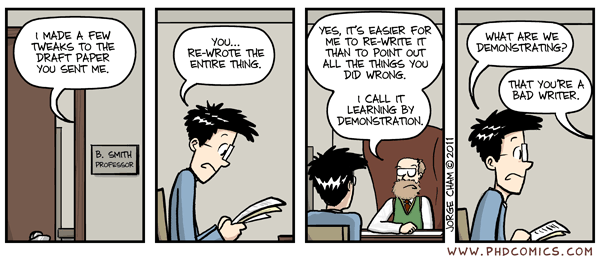
An Editor's Demonstration
I know how this feels. Okay, not completely rewritten, but it sure felt like that at first glance. Here's to hoping the next draft will have fewer crossings-out!
 http://www.phdcomics.com/comics/archive/phd091411s.gif
Tuesday, September 13, 2011
Literature or Confusion
When did it become necessary for literature to be ambiguous, or to explore the dark corners of the human condition without pity or love or even understanding?
Any of those attributes would offer a sense of completeness to a tale well told.
Far too often I read a modern literary work only to feel the killing 'so what?' as I close the book. What did I learn? What experience, what pleasure, what insight did the author grant? If the answer is, 'none', then I have to wonder why it was written. Did the author not know enough, did they deliberately leave holes and unresolved issues, trying to convince the reader the story is true to life?
Life is filled with ambiguities. That is both its chief joy and chief torment. We can never know why things happen as they do. That is why we so love stories. They, like religion, offer the illusion that something is clear, understood, complete.
I often speculate that I must not be capable of reading literature, but then I read books written before, say, 1960, that are in the canon, or books from other countries, and enjoy them. They are stories -- well crafted, illuminating, but complete. Why this modern obsession with unresolved endings? Is the fault in me, or in the modern stars?
I read a modern book -- Finnish, translated -- both literary and a compelling story. Elegant prose, wonderful sense of mood, thought provoking, sympathetic characters (even the ones I didn't like), and though the ending could be called ambiguous, she dropped enough hints throughout the book I was left with not only a stunning twist at the end, but also a good sense of what the protagonist's future life would be. Troll by Johanna Sinisalo.
And I have read modern American novels that I've enjoyed. I am deploring a trend, not an absolute.
Fierce debates rage over the relative merits of literature and genre. If Jane Austen was writing today, where would she be classified? Chick Lit? Okay, I'm being snarky, but almost certainly genre, Women's lit. What about Shakespeare, whose works were enjoyed by all classes? When did he become literature instead of popular entertainment?
If one thinks of literature as illuminating the human condition, offering insights into motivation, dissecting the layers of delusion and confusion we wrap ourselves in, I doubt there is a greater modern master than Terry Pratchett. But he is never admitted to the sacred halls of literature because he writes with humor, irony, and affection.
How would you rather learn: through sympathy, humor, and insightful observation; or through long-winded, tedious, willfully obscure pages of unresolved misery?
Let us be very clear. I am generalizing, but a truth remains.
Literature should not be obscure. It should not hold gloom and despair as its highest attributes. If it aspires to illuminate humanity to itself, then it should understand humanity first. And humans, as a whole, are not keen on pretensions. We want to be with those who care about us, and approach us in ways we can understand; hopefully, to help us see more clearly, think more reasonably, and learn to be a bit wiser.
Who was your favorite teacher at school? The pedant who droned, or the one who spoke to you with interest and enthusiasm? From whom did you actually learn?
An earlier version of this was originally posted in my other blog, but the questions still perplex me: http://thinklovesurvive.wordpress.com/2011/01/06/literature-or-confusion/
Any of those attributes would offer a sense of completeness to a tale well told.
Far too often I read a modern literary work only to feel the killing 'so what?' as I close the book. What did I learn? What experience, what pleasure, what insight did the author grant? If the answer is, 'none', then I have to wonder why it was written. Did the author not know enough, did they deliberately leave holes and unresolved issues, trying to convince the reader the story is true to life?
Life is filled with ambiguities. That is both its chief joy and chief torment. We can never know why things happen as they do. That is why we so love stories. They, like religion, offer the illusion that something is clear, understood, complete.
I often speculate that I must not be capable of reading literature, but then I read books written before, say, 1960, that are in the canon, or books from other countries, and enjoy them. They are stories -- well crafted, illuminating, but complete. Why this modern obsession with unresolved endings? Is the fault in me, or in the modern stars?
I read a modern book -- Finnish, translated -- both literary and a compelling story. Elegant prose, wonderful sense of mood, thought provoking, sympathetic characters (even the ones I didn't like), and though the ending could be called ambiguous, she dropped enough hints throughout the book I was left with not only a stunning twist at the end, but also a good sense of what the protagonist's future life would be. Troll by Johanna Sinisalo.
And I have read modern American novels that I've enjoyed. I am deploring a trend, not an absolute.
Fierce debates rage over the relative merits of literature and genre. If Jane Austen was writing today, where would she be classified? Chick Lit? Okay, I'm being snarky, but almost certainly genre, Women's lit. What about Shakespeare, whose works were enjoyed by all classes? When did he become literature instead of popular entertainment?
If one thinks of literature as illuminating the human condition, offering insights into motivation, dissecting the layers of delusion and confusion we wrap ourselves in, I doubt there is a greater modern master than Terry Pratchett. But he is never admitted to the sacred halls of literature because he writes with humor, irony, and affection.
How would you rather learn: through sympathy, humor, and insightful observation; or through long-winded, tedious, willfully obscure pages of unresolved misery?
Let us be very clear. I am generalizing, but a truth remains.
Literature should not be obscure. It should not hold gloom and despair as its highest attributes. If it aspires to illuminate humanity to itself, then it should understand humanity first. And humans, as a whole, are not keen on pretensions. We want to be with those who care about us, and approach us in ways we can understand; hopefully, to help us see more clearly, think more reasonably, and learn to be a bit wiser.
Who was your favorite teacher at school? The pedant who droned, or the one who spoke to you with interest and enthusiasm? From whom did you actually learn?
An earlier version of this was originally posted in my other blog, but the questions still perplex me: http://thinklovesurvive.wordpress.com/2011/01/06/literature-or-confusion/
Coffee Shop Danger!
Sorry for the hiatus. Been taking a break, and getting new inspirations. More tomorrow, but this is too good to not post.
I feel guilty at long hours in coffee shops. I have a write-together-but-don't-talk-much group I go to on Wednesday afternoons, and we meet in coffee shops. Fortunately not ones that actually reek of coffee. We are not alone -- there are always tables full of people who do just as this article describes:
Café owner going to kill laptop-using bastard
I feel guilty at long hours in coffee shops. I have a write-together-but-don't-talk-much group I go to on Wednesday afternoons, and we meet in coffee shops. Fortunately not ones that actually reek of coffee. We are not alone -- there are always tables full of people who do just as this article describes:
Café owner going to kill laptop-using bastard
Wednesday, August 31, 2011
First Draft Done - Yay, Sooty!
As everyone who writes will know, there is no such thing as finished. One goes through and clears up one set of issues only to emerge at the end with a whole new set.
And thus it was with this first draft. I went through. I cross-checked and verified and inserted required information and elaborated where noted. And all the while I was compiling a list of further changes to make.
The first draft is done. And all that means is that I am now free to start on the second draft. But I am pleased -- and proud that I got it done.
Tomorrow I will be gone for the day, taking a hike around what has to be one of the most beautiful lakes in the world. If I'm not too tired tomorrow night, I will celebrate the first of September by diving into Adjacent Possibilities. All this month I have been jotting ideas for that story. I have a new opening in mind and I want to see if it'll work. I've been following a wonderful series of posts on ethics that have given me ideas for one of the characters. The book's philosophers focus on ethics and beliefs, you see.
So I will enter September actively editing two novels. The third? It haunts me. I wish I could accomplish more, but even five or six straight hours of work can't get me through enough pages: sometimes ten, sometimes twenty, sometimes two.
I am very tired, so I will have to add word count tomorrow.
And tomorrow I will celebrate. Tonight I will sleep!
And thus it was with this first draft. I went through. I cross-checked and verified and inserted required information and elaborated where noted. And all the while I was compiling a list of further changes to make.
The first draft is done. And all that means is that I am now free to start on the second draft. But I am pleased -- and proud that I got it done.
Tomorrow I will be gone for the day, taking a hike around what has to be one of the most beautiful lakes in the world. If I'm not too tired tomorrow night, I will celebrate the first of September by diving into Adjacent Possibilities. All this month I have been jotting ideas for that story. I have a new opening in mind and I want to see if it'll work. I've been following a wonderful series of posts on ethics that have given me ideas for one of the characters. The book's philosophers focus on ethics and beliefs, you see.
So I will enter September actively editing two novels. The third? It haunts me. I wish I could accomplish more, but even five or six straight hours of work can't get me through enough pages: sometimes ten, sometimes twenty, sometimes two.
I am very tired, so I will have to add word count tomorrow.
And tomorrow I will celebrate. Tonight I will sleep!
Monday, August 29, 2011
What Makes A Real Character?
What makes a 'real' character?
I read many posts on the topic. They seem to involve check lists, formulas you can plug in and hey, presto, you have a three dimensional, well rounded, believable, likable (even the bad-guys) character.
I know it can not, does not work that way. No formula can replace authenticity. But how do you create authenticity?
Writing is a reflection of reality. It is also a simplification. We want a story to have a clear arc from beginning to end. We want to see how things have changed. Real-life people don't often change much. Lottery winners are a good example. Sudden wealth alters their lives for a short while, then they settle back into old habits. But in stories we expect our lead characters to change. We want the exceptional, not the normal.
Each genre has its own expectations of how real a character must be. Much as I love cozy mysteries, soft science fiction, and fantasy, the characters tend to be flat. This doesn't mean we don't like them, or loathe them, only that we usually know right up front if they are the good guys or the bad guys. No grey areas. We learn a few quirks and we're done. In a series it gets complicated. The author has to keep adding traits and life-history, leaving us to wonder why we didn't know about them earlier on. Literary fiction is more like life. We can see the complexities of human nature more realistically portrayed.
When you step back and think about a day -- even an hour in your life, how many fleeting moods, random thoughts, odd memories, half-completed actions are there? Far too many to ever account for. But they reflect the prism of your personality.
I want my characters to have those facets.
No one is without moments of weakness, and no one is always weak. No one speaks uniformly good or ill or anyone or anything, unless they are speaking from hate or prejudice.
Normal people like and dislike aspects of people and life. A real teacher will complain of annoying students while also glorying in the good ones. My characters should be real enough to do the same.
What's important is that behind the specific attributes of a character, we can clearly see their core nature. Speaking ill of a bad person is consistent with a 'good' character. If they find they made a bad judgement they will try to rectify it. But they will still make occasional bad judgements. We all do.
To label a character good or bad, then assign a few traits or habits to flesh them out doesn't create a person, only a stereotype with garnish. But give that character too much reality, and the reader might become confused.
So, let the reader know how you feel about the character. Do you like them? Why? Choose a few aspects of their nature to focus on. Don't be afraid to show them as inconsistent. When you do, though, be sure to refocus on why that seems inconsistent -- get back to the core.
An example: if my enthusiastic teacher dislikes a student, that seems inconsistent. But if she says the student is a trouble maker, then we understand that it's the student who's the problem, not the teacher. She's a real person, just like you and me, one who reacts to stimuli, and not an inert mass of attributes selected from a check list.
Real characters, like real people, are complex. As a writer, we have to give a sense of that complexity in a simplified form. Not an easy task.
I read many posts on the topic. They seem to involve check lists, formulas you can plug in and hey, presto, you have a three dimensional, well rounded, believable, likable (even the bad-guys) character.
I know it can not, does not work that way. No formula can replace authenticity. But how do you create authenticity?
Writing is a reflection of reality. It is also a simplification. We want a story to have a clear arc from beginning to end. We want to see how things have changed. Real-life people don't often change much. Lottery winners are a good example. Sudden wealth alters their lives for a short while, then they settle back into old habits. But in stories we expect our lead characters to change. We want the exceptional, not the normal.
Each genre has its own expectations of how real a character must be. Much as I love cozy mysteries, soft science fiction, and fantasy, the characters tend to be flat. This doesn't mean we don't like them, or loathe them, only that we usually know right up front if they are the good guys or the bad guys. No grey areas. We learn a few quirks and we're done. In a series it gets complicated. The author has to keep adding traits and life-history, leaving us to wonder why we didn't know about them earlier on. Literary fiction is more like life. We can see the complexities of human nature more realistically portrayed.
When you step back and think about a day -- even an hour in your life, how many fleeting moods, random thoughts, odd memories, half-completed actions are there? Far too many to ever account for. But they reflect the prism of your personality.
I want my characters to have those facets.
No one is without moments of weakness, and no one is always weak. No one speaks uniformly good or ill or anyone or anything, unless they are speaking from hate or prejudice.
Normal people like and dislike aspects of people and life. A real teacher will complain of annoying students while also glorying in the good ones. My characters should be real enough to do the same.
What's important is that behind the specific attributes of a character, we can clearly see their core nature. Speaking ill of a bad person is consistent with a 'good' character. If they find they made a bad judgement they will try to rectify it. But they will still make occasional bad judgements. We all do.
To label a character good or bad, then assign a few traits or habits to flesh them out doesn't create a person, only a stereotype with garnish. But give that character too much reality, and the reader might become confused.
So, let the reader know how you feel about the character. Do you like them? Why? Choose a few aspects of their nature to focus on. Don't be afraid to show them as inconsistent. When you do, though, be sure to refocus on why that seems inconsistent -- get back to the core.
An example: if my enthusiastic teacher dislikes a student, that seems inconsistent. But if she says the student is a trouble maker, then we understand that it's the student who's the problem, not the teacher. She's a real person, just like you and me, one who reacts to stimuli, and not an inert mass of attributes selected from a check list.
Real characters, like real people, are complex. As a writer, we have to give a sense of that complexity in a simplified form. Not an easy task.
Friday, August 26, 2011
Humor For Sooty (and Chemistry)
Gotta love these. Lolcats has been running a series of Chemistry Cat jokes, and now Saturday Morning Breakfast Cereal gets in on the act.
Chemistry is part of Sooty's story, you see. Again, I find synchronicity. When I work on Adjacent Possibilities, the world is full of philosophy, and when I work on Sooty, chemistry.
Of course, I know it's only that I notice these things because I'm thinking about them, but even that is good. It means I'm seeing things I wouldn't have noticed before.
Wonderful!

(sorry about the overlap, but using a smaller size-option made this one unreadable)
Chemistry is part of Sooty's story, you see. Again, I find synchronicity. When I work on Adjacent Possibilities, the world is full of philosophy, and when I work on Sooty, chemistry.
Of course, I know it's only that I notice these things because I'm thinking about them, but even that is good. It means I'm seeing things I wouldn't have noticed before.
Wonderful!

(sorry about the overlap, but using a smaller size-option made this one unreadable)
Update 23 Oct, 2011 I was just going over old posts and saw this image had vanished. I can't get it to reload, so here's the direct link to the comic from its site's archives:
http://www.smbc-comics.com/index.php?db=comics&id=2349
Tuesday, August 23, 2011
Self-Deception
One of the themes that always pokes its way into my stories is integrity. Not being who you think you should be, or who you think others want you to be, but rather, finding who you truly are.
Facing facts is a tangent of that. And yet, self-delusion can be helpful. It gets us through times of hardship. "This, too, shall pass." "It's always darkest just before dawn," "Light at the end of the tunnel." Myriad proverbs to choose from, all telling us that we needn't give up hope, needn't face facts. Instead, we can adapt reality to make us comfortable.
So, we have to find a balance between accepting reality clearly enough that we can deal with life as it is, but not so bluntly that we become despairing or incapable of action.
My re-interpretation of reality was that I could write a novel in a month, including at least one thorough round of editing and revision, and then publish it as an ebook. I cheerfully announced that I would let it go, knowing it wouldn't be a good as it could be, because I need the satisfaction of having something 'finished' and out-there. Also, I need to learn how to get ebooks formatted for the various distribution sites.
My learning novel, I called it.
And now I find I cannot do it. Oh, I can have it written. I can revise it, too; I already am. I find I cannot write the outline that will facilitate said revisions without stopping to implement them. No self-restraint, alas. So I will meet those goals.
But -- I cannot put a book out into the world unless I make it something I'm proud of. So now I see myself with not just two novels in editing, but three.
I have to get back to Adjacent Possibilities. I've learned so much from the Sooty Experiment, and the editing will go more easily because of that. But I did so want to believe I could relax and accept an adequate novel, just for the sense of accomplishment in saying: I have a story available.
I'll keep to my month. I'll get Sooty written. I've already spoken to an editor, too, to provide that so-necessary extra pair of eyes. I'll get Sooty shaped up to where I can let it try its proverbial wings. I cannot say when, but I'm now hoping by mid-October. Still very fast, I know. But I'm trying to find that precarious balance between the sense of completion I need and the sense of pride I have to have in my work.
( Update: I should clarify. I normally do not write so swiftly. For the other two novels-in-editing, one is going on for almost 2 years, the other, Adjacent Possibilities, for just over a year. Both are still being researched as well as edited and revised, and for both I sometimes wonder how one ever knows when something is finished. All I know is that neither of them is finished, nor will be for many months, perhaps years to come. )
Word counts are not totally abandoned, but I'm letting them slide until I get the outline done. Then I'll get the middle written, and have a completed first draft to announce.
Facing facts is a tangent of that. And yet, self-delusion can be helpful. It gets us through times of hardship. "This, too, shall pass." "It's always darkest just before dawn," "Light at the end of the tunnel." Myriad proverbs to choose from, all telling us that we needn't give up hope, needn't face facts. Instead, we can adapt reality to make us comfortable.
So, we have to find a balance between accepting reality clearly enough that we can deal with life as it is, but not so bluntly that we become despairing or incapable of action.
My re-interpretation of reality was that I could write a novel in a month, including at least one thorough round of editing and revision, and then publish it as an ebook. I cheerfully announced that I would let it go, knowing it wouldn't be a good as it could be, because I need the satisfaction of having something 'finished' and out-there. Also, I need to learn how to get ebooks formatted for the various distribution sites.
My learning novel, I called it.
And now I find I cannot do it. Oh, I can have it written. I can revise it, too; I already am. I find I cannot write the outline that will facilitate said revisions without stopping to implement them. No self-restraint, alas. So I will meet those goals.
But -- I cannot put a book out into the world unless I make it something I'm proud of. So now I see myself with not just two novels in editing, but three.
I have to get back to Adjacent Possibilities. I've learned so much from the Sooty Experiment, and the editing will go more easily because of that. But I did so want to believe I could relax and accept an adequate novel, just for the sense of accomplishment in saying: I have a story available.
I'll keep to my month. I'll get Sooty written. I've already spoken to an editor, too, to provide that so-necessary extra pair of eyes. I'll get Sooty shaped up to where I can let it try its proverbial wings. I cannot say when, but I'm now hoping by mid-October. Still very fast, I know. But I'm trying to find that precarious balance between the sense of completion I need and the sense of pride I have to have in my work.
( Update: I should clarify. I normally do not write so swiftly. For the other two novels-in-editing, one is going on for almost 2 years, the other, Adjacent Possibilities, for just over a year. Both are still being researched as well as edited and revised, and for both I sometimes wonder how one ever knows when something is finished. All I know is that neither of them is finished, nor will be for many months, perhaps years to come. )
Word counts are not totally abandoned, but I'm letting them slide until I get the outline done. Then I'll get the middle written, and have a completed first draft to announce.
Sunday, August 21, 2011
Oops -- Revising Before Finishing
I haven't written in the last two days, but I have been poking about at the Sooty story, adding bits, taking out bits. And I've gotten quite a few notes of character development, plot points to clear up, and such. And pondering over a title for it. Sooty just won't do.
I've spent a day running errands, and another day on a wonderful hike to a new and different waterfall in the Coastal mountains. That walk will find its way into the women's fiction, Adjacent Possibilities, that I am currently not-editing, and hence grieving for. I have been making notes for it, too, as I write the Sooty novel. It is always in my mind, as is the third novel, the crossover speculative fiction. And all the other stories I can't wait to write.
"If we had world enough, and time..."
Part of the problem is that having been writing from the beginning forward as well as from the ending backward, I now need to meet in the middle. This was confusing me. So I opted to stop writing the middle until I got a detailed-note outline completed.
I dedicated myself to that today, but am barely a quarter of the way through it, as I keep stopping to adjust the story. And also stopping to do laundry, to answer the phone, to feed the cats, to take care of dinner, to move the sprinkler in the flower beds, and to walk to the frozen yoghurt shop after dark with my kids. Sundry things that take many little snippets of time and are distracting.
But then, that's also part of why I chose to work on the outline today. It's more forgiving of interruptions as there's no sweeping chain of thoughts to be broken off and perhaps forgotten.
This is why I growl when male writers thank their wives for taking care of daily life for them so they can write. Who, I ask again, takes care of married women writers?
I've spent a day running errands, and another day on a wonderful hike to a new and different waterfall in the Coastal mountains. That walk will find its way into the women's fiction, Adjacent Possibilities, that I am currently not-editing, and hence grieving for. I have been making notes for it, too, as I write the Sooty novel. It is always in my mind, as is the third novel, the crossover speculative fiction. And all the other stories I can't wait to write.
"If we had world enough, and time..."
Part of the problem is that having been writing from the beginning forward as well as from the ending backward, I now need to meet in the middle. This was confusing me. So I opted to stop writing the middle until I got a detailed-note outline completed.
I dedicated myself to that today, but am barely a quarter of the way through it, as I keep stopping to adjust the story. And also stopping to do laundry, to answer the phone, to feed the cats, to take care of dinner, to move the sprinkler in the flower beds, and to walk to the frozen yoghurt shop after dark with my kids. Sundry things that take many little snippets of time and are distracting.
But then, that's also part of why I chose to work on the outline today. It's more forgiving of interruptions as there's no sweeping chain of thoughts to be broken off and perhaps forgotten.
This is why I growl when male writers thank their wives for taking care of daily life for them so they can write. Who, I ask again, takes care of married women writers?
Wednesday, August 17, 2011
Sooty Update
I only wrote 200 words today. I had revised the first few pages to take to my critique group, and then, working off their suggestions, revised the scene more this evening.
I've been working on the foreshadowing in this scene. Anna starts seeing things in weird new ways, but she doesn't know why -- after all, she hasn't met Sooty yet!
So, here's the current revision of the opening - previously seen here.
Sooty -- Opening Scene
I've been working on the foreshadowing in this scene. Anna starts seeing things in weird new ways, but she doesn't know why -- after all, she hasn't met Sooty yet!
So, here's the current revision of the opening - previously seen here.
Sooty -- Opening Scene
Anna huddled on her bed, clutching a pillow. They were at it again. Not quite fighting, but arguing. It seemed as if they were always arguing lately. Her tightly shut door couldn't block the sounds from the living room down the hall, voices that echoed in her as if she heard not through her ears but in her mind, and left her stomach churning acid sour. It didn’t take any brains to figure out her mom was unhappy, but why'd she have to make the rest of them unhappy, too?
In her mind's eye, clear as clear, she saw her dad hunkered down in his big chair, his puff of pale blond hair sticking up over the back. He was holding a book, one finger carefully marking his place. The TV was on, though muted, and he was glancing furtively at the flickering images.
His image was also flickering, as if she were seeing him through a camera lens while adjusting the focus. And when her mind twisted itself to a slightly new focus, she could see waves streaming out from the lamp beside the chair, and from the television – even from Dad himself. Waves of energy that overlapped in interference patterns like she'd seen in science class.
Her vision spread. There was Mom, tall, straight. If Dad were flickering, Mom was a laser. Her energy, or whatever it was Anna was seeing, was so intense it was hard to look at her. Anna felt her mind pulling back, observing with something more like normal vision again.
Despite her anxiety, Anna's curiosity was aroused. She'd never seen anything so clearly in her imagination before. And certainly never seen energy from people and lamps. Was it a stress induced hallucination? In unconscious habit, she filed the puzzling thought away for future consideration.
Her mom's voice rose, words that sounded like needing to be herself or something. Why? She had a job she loved, a family she said she loved – what more could she want?
Out of the rumbling that followed that proclamation, her mother snarled, “All you see is boobs. You never think about the person they're attached to.”
A growling sound. Her father shouting – actually shouting, “I thought sex was what this is all about?”
Anna's vision of the scene in the living room shattered. She didn't want to hear any more, either, and twisted around to drop face first onto her bed, squashing the pillow firmly over her ears. It did no good; she was still aware of her parents in her head, aware of the tense silence between them as the echoes of her father's shout jostled the corners of mind.
And then her mom laughed, an awkward, gulping sort of laugh.
That was a real sound. Intrigued, Anna jumped up and ran to press her ear against the crack between the door and its frame. She could hear their voices, talking now, not shouting, but she couldn't make out any more words. She brushed uncooperative straggles of her soft brown hair from her eyes and shuffled back to sit on her bed.
She wasn't imagining things now, but she knew from experience that while Dad was listening to Mom, he was also hoping for distractions to save him from having to commit himself to a clear statement. That was how he disciplined her and her brother, Alan, too. Tried to discipline. He'd start by laying down the law, then sidle over to one side, then the other, and end by saying do what you think best. But do think, and do be careful, okay?
The tight muscles in her face softened in a brief smile and stayed soft even when she thought about her mom. Mom did lay down the law, but, as she and Alan both had to admit, never unreasonably. She rarely issued her decrees, but when she did, what she said was absolute.
Footsteps in the hall. Anna froze, a rabbit in headlights. The footfall stopped at her door. Someone knocked. Not someone. She knew who it was. Mom.
She grabbed the pillow again and squeezed it hard If only she had something alive to cuddle. Her friend Jay had a cat, a big fluffy calico. Anna loved to pet it and hear its rumbling purr. Just looking at it made her feel soft and cozy. She could use that comfort right now.
She'd asked her parents if she could get a cat. They'd said no.
“Anna?” Just as she'd expected, her mother's voice.
Oh boy. When Mom had been arguing with Dad, she often came in to talk at Anna. And usually it was the same speech. Don't waste your opportunities. Don't try to be someone you're not. And oh, by the way, you need to be more outgoing. Get more friends. Maybe try a new hairstyle. Not that her floppy straight brown hair would hold a style. Even the permanent her mom had coaxed her into a couple years ago had flopped. And she preferred glasses. Putting her contacts in took too long, even if Mom did say her dark eyes were pretty.
Anna sighed. “What?”
Her mom opened the door slowly, then peeked around to catch Anna's eyes. "Can I talk to you a second?"
When Anna nodded, her mom stepped in, her hand gripping the edge of the door as she closed it almost shut. She stood that way, her lips pressed tightly together, her eyes on the floor, until with a visible breath she let her hand fall. She leaned against the door, and it closed with a sharp click. She seemed diamond hard, yet once again shimmering, as if Anna could see the aura of her life force. Her best friend Tai was always on about such things. Maybe Tai wasn't crazy.
How strange, Anna thought. It's as if I've never seen her before. Or, she reflected, as if I'm seeing her through someone else's eyes. She studied her mom's face, long and thin – a well bred horse, Dad used to say as he tugged mom's long black ponytail affectionately. Thin – too thin, Anna now realized. Just being around Mom was exhausting. She never seemed to slow down, even when she was, in theory, relaxing. And she was always vibrating with energy that, for some reason, Anna could now see.
How strange, Anna thought. It's as if I've never seen her before. Or, she reflected, as if I'm seeing her through someone else's eyes. She studied her mom's face, long and thin – a well bred horse, Dad used to say as he tugged mom's long black ponytail affectionately. Thin – too thin, Anna now realized. Just being around Mom was exhausting. She never seemed to slow down, even when she was, in theory, relaxing. And she was always vibrating with energy that, for some reason, Anna could now see.
“Anna… I'm sorry about the yelling. I've been trying to make a decision. I need to do something.”
Anna didn't answer; she was waiting for the rest of the lecture. Instead, she lowered her head and made sharp little folds in the sheets.
Her mom fidgeted around the room, opening and closing drawers, straightening the papers on the desk, twirling the cord of the blinds.
Her mom fidgeted around the room, opening and closing drawers, straightening the papers on the desk, twirling the cord of the blinds.
“Anna, I do love you. And Alan. And I love your father. Please try to understand.” She let fall the cord, turned, and left the room, closing the door gently behind her.
She was gone. There'd been no time for a reply, even if Anna had had one to offer.
Anna held held up her hands. She noted, with almost clinical interest, that they were shaking. She let them fall, and turned her head to stare blindly at the closed door. Something was going to happen. She had no idea what, but she knew it wouldn't be good.
The last few months had taught her how to cope with the turmoil she felt. Turn yourself into a robot, that's the trick. Finish homework, then get ready for bed, everything mechanical, without thought. It got things done, even if it couldn't make things better. Tonight, though, her mind wasn't cooperating as she'd like. She kept going back to that one exchange between her parent, about boobs and sex. Was that what the problem was? It wasn't something she wanted to think about.
That night she dreamed, a strange dream, unlike any she'd had before. She dreamt she was a ghost, or something inhuman like that. Without shape or form, but not void. She dreamt she looked about her and saw the world as shimmers of energy, as of heat mirages above baking pavements in the summer. Everything shimmered, even the people she passed.
She wasn't walking. She drifted like a puffball from a dandelion, caught in currents and eddies, not of air, but of energies emitted by people and objects.
Then she slid through a person, feeling in one bright flash all their thoughts, their dreams, their fears. She woke, choking on a scream that wouldn't come out.
Dawn was barely lighting the window, but Anna didn't try to go back to sleep. She sat on the edge of her bed, pressing her forehead into her hands as if to force her mind to serenity. More hallucinations. I'm really messed up, she told herself. I need to get my act together.
She pulled on her glasses, stood and stretched tall, then stumbled over to her desk. The internet would distract her, and help her to put her dream, and the visions of her parents that she'd imagined the night before, out of her mind.
Updated: I reread this, and felt it wasn't quite my writing. I keep running into this. I am not a florid, descriptive writer. I am told I have to put more description in, more tags that anchor dialogue to an action. That is not how I like to write. Yes, I need more, but rereading the above, there is too much. It is not me.
Writing is so bloody hard to learn, and it's even harder to find and develop your voice when others want something different from you.
I keep striving.
Updated: I reread this, and felt it wasn't quite my writing. I keep running into this. I am not a florid, descriptive writer. I am told I have to put more description in, more tags that anchor dialogue to an action. That is not how I like to write. Yes, I need more, but rereading the above, there is too much. It is not me.
Writing is so bloody hard to learn, and it's even harder to find and develop your voice when others want something different from you.
I keep striving.
Subscribe to:
Posts (Atom)