I keep clicking. My perceptions of objective reality obviously need new settings.
http://make-everything-ok.com/
Showing posts with label belief. Show all posts
Showing posts with label belief. Show all posts
Monday, January 16, 2012

Monday, December 5, 2011
Mirrors
Mirrors are odd things. They're how we see ourselves, but it's a reversed seeing. Yet they're perhaps the most common way we know to visualize ourselves.
If I tell myself to touch the right side of my face, my hand goes up to touch my cheek. No problem. But looking in a mirror, touching the right side of my mirror-face, the hand wants to cross over.
It's as if my image were another person; that would be their right side. So what I see in the mirror is a perceptual mix of myself and an imagined 'other person' looking at me.
We see bits and pieces of ourselves in mirrors. I can brush my teeth before a mirror and come away with no idea whether or not my hair is tidy. I can see what I want to see to some degree. It becomes trickery to allow myself to see my image without that filter.
Such an odd thing to see yourself in a mirror unexpectedly. For a sharp moment you see a stranger. For an instant, you see yourself as others see you. Then the filters kick in and you see you.
Such honesty can be hard to bear, either from mirrors or from other people.
People are mirrors for one another. We mimic words and gestures of those we get close to, even of strangers. We are influenced by the moods written in their faces, their gestures, their voices.
We see how other people act. If we admire it, we want to take it in and reflect it back from ourselves. Smiling makes us feel happier. Acting strong changes our hormones and makes us strong. We can make ourselves to be more as we wish to be. Mirroring others is part of that process.
Friends reveal so much of who you are. Who are they when they're with you? Long term relationships can become reflections of reflections, both of you mirroring long-past conceptions or stages with perhaps no validity in the present. Habits. If you disrupt the reflections you fragment the relationship.
This can be good. It lets you both see one another as who you are, not who you are in your interpreted reflections of one another. But it can also mean that instead of a friend you see a stranger, and all you share now are those long-established mutually reflecting images.
A friend who reflects you truly – why does that happen? It can be hard to bear, to have to be honest with them and with yourself. It is also liberating. If they're still around after that honesty, they truly are a friend.
Friendship. Seeing another person for who they are, not who you want / need them to be. Taking what is weak or unkind in them and holding it in gentle hands, helping them accept and improve that part of themselves. Recognizing what is noble and wise in them and honoring that, taking it into yourself and giving it back to them with humility and gratitude. Giving them the joy of loving them for all those facets, not just for the few you like best.
Letting them love who you are, too.
Sunday, October 30, 2011
Kids or Spouse?

A friend and I had just been discussing this question. We wondered how many other women question this. Of course, there's two sides to the question: kids and no spouse, or spouse and no kids. Either way, society often frowns.
I'm thinking a lot about cultural myths lately. Tradition dictates marriage and family. But in this as in all things, people should be free to choose -- and most importantly, society should support those choices. It's all too easy to feel guilty for wanting a non-traditional life.
Then I think about choices that are even more non-traditional, and I am once again humbled at the courage people have, who choose not to hide who they are: different sexual orientations, gender change, even (omg) atheists.
We are getting better, I think, as a society, but there's still so much intolerance, even hatred for those who don't abide by a perceived norm. But what is normal, and why? And who decides?
I think it's easier on everyone to stop insisting we have the right to tell others how to live, and ask instead for respect. Be kind. That's all.
http://www.arcamax.com/newspics/28/2805/280589.jpg
Tuesday, October 25, 2011
Anoesis: How New Words Open New Worlds
Yesterday morning I learned a new word. Such a delight (thanks to word of the day). There are words that I feel the lack of. One is a word for the deliberate act of ignoring. If I say ignorance, (IG-nor-ance) it means I don't know. But I want a word for ig-NOR-ance. Humans are very good at deliberately ignoring things, so why is there no word for it?
Yesterday's treasure was Anoesis: being flooded with emotion or sensation, and unable to form rational thought about it. And the most peculiar thing happened. That afternoon I was plunged into anoesis.
I love to analyze, and having a label for that abstract, overwhelming, compelling state helped. Of course, I was trying to find a way to express this state of being so I could use it in a novel, but also to help me understand why I felt that way.
Like the apparent duality in physics, I live in a Newtonian world. My still-enduring moment of anoesis plunged me into a Quantum universe where all I know and think is altered, pulsing to different energies and perceptions. The quantum universe underlies all I think I know. I, too, am looking for a grand unification of what I am and what I seem to be.
Words are not dangerous things, but they do foment revolutions, personal or global.
Yesterday's treasure was Anoesis: being flooded with emotion or sensation, and unable to form rational thought about it. And the most peculiar thing happened. That afternoon I was plunged into anoesis.
I love to analyze, and having a label for that abstract, overwhelming, compelling state helped. Of course, I was trying to find a way to express this state of being so I could use it in a novel, but also to help me understand why I felt that way.
Like the apparent duality in physics, I live in a Newtonian world. My still-enduring moment of anoesis plunged me into a Quantum universe where all I know and think is altered, pulsing to different energies and perceptions. The quantum universe underlies all I think I know. I, too, am looking for a grand unification of what I am and what I seem to be.
Words are not dangerous things, but they do foment revolutions, personal or global.
Sunday, October 23, 2011
Anti-Intellectual Incompetence
An interesting post from Massimo Pigliucci at Rationally Speaking.
I was particularly intrigued because I had just read yet another 'discussion' on religion vs. science, where the arguers for religion were chronically unable to discern the difference between proof and belief. If one cannot make that very gaping distinction, there is no hope of discussion. I admit to feeling there is no need for discussion. Religion, in this so global modern world, should be private and personal, and ought not to be imposed on others. My beliefs are mine; theirs are theirs. But provable information -- that is the realm of the public domain.
This article discusses another false dichotomy: intellectualism vs engineers. Timothy Ferris of 'Wired Magazine' argues that only productive technology is worthwhile (does he work for Perry?) and that thinking, ideas, and intellectual processes are a waste of time.
How, I wonder, did he get the education that allowed him to think about this? Not that he did much thinking. It is clear he is bias-promotion rather than genuine reasoning in his article.
Massimo makes several good points, most notably that Ferris "makes his case by cherry picking examples, distorting history, and simply ignoring what is not convenient for his thesis." He provides examples to support this claim.
Later, Massimo says, "five minute of serious reflection should have made Ferris realize that he created a straw man with precious little correspondence to reality." Again, he offers counter arguments worth considering.
I am, as with religion vs science, willing to allow both sides validity. I see them as reflecting different aspects of human nature and need. I have always been grossly suspicious of any premise that requires absolute exclusive validity. Nature vs Nurture. Particle vs Wave. Life is seldom so clear cut. My guiding principle is 'it's a spectrum' and from that beginning, I proceed, cautiously, to determine how dark or light the shades of grey are on any issue.
Well worth reading: http://rationallyspeaking.blogspot.com/2011/10/engineers-vs-intellectuals-how-timothy.html
I was particularly intrigued because I had just read yet another 'discussion' on religion vs. science, where the arguers for religion were chronically unable to discern the difference between proof and belief. If one cannot make that very gaping distinction, there is no hope of discussion. I admit to feeling there is no need for discussion. Religion, in this so global modern world, should be private and personal, and ought not to be imposed on others. My beliefs are mine; theirs are theirs. But provable information -- that is the realm of the public domain.
This article discusses another false dichotomy: intellectualism vs engineers. Timothy Ferris of 'Wired Magazine' argues that only productive technology is worthwhile (does he work for Perry?) and that thinking, ideas, and intellectual processes are a waste of time.
How, I wonder, did he get the education that allowed him to think about this? Not that he did much thinking. It is clear he is bias-promotion rather than genuine reasoning in his article.
Massimo makes several good points, most notably that Ferris "makes his case by cherry picking examples, distorting history, and simply ignoring what is not convenient for his thesis." He provides examples to support this claim.
Later, Massimo says, "five minute of serious reflection should have made Ferris realize that he created a straw man with precious little correspondence to reality." Again, he offers counter arguments worth considering.
I am, as with religion vs science, willing to allow both sides validity. I see them as reflecting different aspects of human nature and need. I have always been grossly suspicious of any premise that requires absolute exclusive validity. Nature vs Nurture. Particle vs Wave. Life is seldom so clear cut. My guiding principle is 'it's a spectrum' and from that beginning, I proceed, cautiously, to determine how dark or light the shades of grey are on any issue.
Well worth reading: http://rationallyspeaking.blogspot.com/2011/10/engineers-vs-intellectuals-how-timothy.html
Saturday, September 24, 2011
Writing, Bacteria, Evolution, and Rules
I wasn't sure which blog to post this article to. It is science, yes, but it is also philosophy, and very little thought was required to turn that philosophy into writing advice. So, writing, philosophy, and science? Sounds like it belongs right here.
How Life Arose on Earth, and How a Singularity Might Bring It Down
September 23, 2011
The origins of life; the process of evolution; the dangers of too rapid growth, but also of stagnation.
Can you see the application to writing?
There is a quote early on, from Sean Carroll. He blogs at Cosmic Variance.
“The purpose of life,” meeting co-organizer and Caltech cosmologist Sean Carroll said in his opening remarks, “is to hydrogenate carbon dioxide.”
Well, that's a downer for all of us who want to believe there's something inherently unique and purposeful about humanity. But as a writer, I see that as a call to remember the true purpose of my work: to write stories.
Writers are not marketing machines; we are not role-models; we are not advocates for this, that, or anything. Of course, these are aspects of our work, but they are tangential, not essential to what we do. Writers tell stories. In non-fiction, writers provide information.
That's it. That is our whole reason to be. To write. Anything else is the proverbial icing on the cake. Don't get so caught up in the add-ons that you lose sight of your true purpose. Just tell stories.
Back to the article. Inorganic reactions become biological reactions.The evolution of life-forms was driven by the spontaneous generation of complexity.
In writing, we start with a few tools. Words. Sentences. Grammar. Themes that determine how we arrange those elements. Then we reach a critical level, and the ideas take over, dictating the words, forcing the patterns into new lines.
Some people say their characters take over the story and they can no longer tell them what to do. Such willfulness is analogous to the emergence of biological reactions in evolution. What these writers are saying is that the story has found its life. It has evolved from connected words to an entity with a need to grow and develop.
Just as there are millions upon millions of life forms in the past, present, and future of our world, so too are there millions of stories. Like life, they rely on a few basic structures, but also like life, the pressures of their environment, the resources they have, the stimuli they perceive will alter and adapt them in to myriad forms.
Nothing new under the sun? Quite correct. It is not new, it is the history of life and of literature to constantly create new permutations, new adaptations. Infinite variety.
The article goes on to discuss how a strain of bacterium discovered they could use the citrate in their agar, rather than depend upon the glucose. This evolutionary adaptation proved repeatable. (I loved the comment, "Sympathetic murmurs of pity for the grad students spread through the FQXi audience." Grad students do all the long, tedious slog-work essential for science) It's not just making stuff up, folks. It's an incredible amount of painstaking, repetitious labor that leads to science. That's why we don't call it science unless it can be proven and repeated. Not at all the same thing as merely wanting it to be true.
In writing, the old patterns work. We are taught how to craft a sentence, how to develop a character, how to 'show-don't-tell.' But if we read, we discover that the greatest writers break the rules and enhance, even throw out the accepted forms. They bring new ways of telling stories into the world. Innovation drives literature as surely as it drives life.
Many, perhaps most innovations will fail. But a few succeed. Don't be afraid to try new styles, new characters. Never let yourself fall into believing that there's a one-and-only way to write. That said, like the bacteria in the experiment, there's a reason why we are taught rules. They work. If you innovate, you may fail. Be warned.
The end of the article discusses how different systems follow similar patterns. Bacteria, cities, humanity: all follow predictable relations. Smaller organisms have faster metabolisms. People in cities walk faster. And short stories require tighter, more urgent pacing.
Complexity theorist. Now there's a job title I'd love to have. "Complexity theorist Raissa D’Souza of U.C. Davis argued in her talk that when you have coupled complex systems, any break in the growth trends tends to be accompanied by wild fluctuations. Modern society is predicated on growth; stability is tantamount to collapse."
I've long wondered why humans in western cultures are so obsessed with growth. The town I live in, a delightful, charming place, is being destroyed by growth. The university is being mutated into a cancer that absorbs and destroys the quality of life for the campus and the town. But it will be a Big University, and that is, alas, all that matters.
Snarking aside, being big is not, by default, better. Books are too often too long. Don't be afraid to cut. Remove whole scenes. The joy of computer-aided writing is that you can copy out the entire novel in a blink, tear it to shreds, rearrange the bits, keep what works, paste that into a new version, and delete the rest.
Do hire an editor. They aren't enamored with your words, only with the finished product. They have the objectivity to see what is extraneous where you can't bear to let anything go. Trust your editor!
The final advice of the article is one all writers hear frequently. Get off the internet.
Time, lots of time, gave us life on earth. Even more sweeps of time gave us our selves. What's a few months to give life to your words?
How Life Arose on Earth, and How a Singularity Might Bring It Down
September 23, 2011
The origins of life; the process of evolution; the dangers of too rapid growth, but also of stagnation.
Can you see the application to writing?
There is a quote early on, from Sean Carroll. He blogs at Cosmic Variance.
“The purpose of life,” meeting co-organizer and Caltech cosmologist Sean Carroll said in his opening remarks, “is to hydrogenate carbon dioxide.”
Well, that's a downer for all of us who want to believe there's something inherently unique and purposeful about humanity. But as a writer, I see that as a call to remember the true purpose of my work: to write stories.
Writers are not marketing machines; we are not role-models; we are not advocates for this, that, or anything. Of course, these are aspects of our work, but they are tangential, not essential to what we do. Writers tell stories. In non-fiction, writers provide information.
That's it. That is our whole reason to be. To write. Anything else is the proverbial icing on the cake. Don't get so caught up in the add-ons that you lose sight of your true purpose. Just tell stories.
Back to the article. Inorganic reactions become biological reactions.The evolution of life-forms was driven by the spontaneous generation of complexity.
In writing, we start with a few tools. Words. Sentences. Grammar. Themes that determine how we arrange those elements. Then we reach a critical level, and the ideas take over, dictating the words, forcing the patterns into new lines.
Some people say their characters take over the story and they can no longer tell them what to do. Such willfulness is analogous to the emergence of biological reactions in evolution. What these writers are saying is that the story has found its life. It has evolved from connected words to an entity with a need to grow and develop.
Just as there are millions upon millions of life forms in the past, present, and future of our world, so too are there millions of stories. Like life, they rely on a few basic structures, but also like life, the pressures of their environment, the resources they have, the stimuli they perceive will alter and adapt them in to myriad forms.
Nothing new under the sun? Quite correct. It is not new, it is the history of life and of literature to constantly create new permutations, new adaptations. Infinite variety.
The article goes on to discuss how a strain of bacterium discovered they could use the citrate in their agar, rather than depend upon the glucose. This evolutionary adaptation proved repeatable. (I loved the comment, "Sympathetic murmurs of pity for the grad students spread through the FQXi audience." Grad students do all the long, tedious slog-work essential for science) It's not just making stuff up, folks. It's an incredible amount of painstaking, repetitious labor that leads to science. That's why we don't call it science unless it can be proven and repeated. Not at all the same thing as merely wanting it to be true.
In writing, the old patterns work. We are taught how to craft a sentence, how to develop a character, how to 'show-don't-tell.' But if we read, we discover that the greatest writers break the rules and enhance, even throw out the accepted forms. They bring new ways of telling stories into the world. Innovation drives literature as surely as it drives life.
Many, perhaps most innovations will fail. But a few succeed. Don't be afraid to try new styles, new characters. Never let yourself fall into believing that there's a one-and-only way to write. That said, like the bacteria in the experiment, there's a reason why we are taught rules. They work. If you innovate, you may fail. Be warned.
The end of the article discusses how different systems follow similar patterns. Bacteria, cities, humanity: all follow predictable relations. Smaller organisms have faster metabolisms. People in cities walk faster. And short stories require tighter, more urgent pacing.
Complexity theorist. Now there's a job title I'd love to have. "Complexity theorist Raissa D’Souza of U.C. Davis argued in her talk that when you have coupled complex systems, any break in the growth trends tends to be accompanied by wild fluctuations. Modern society is predicated on growth; stability is tantamount to collapse."
I've long wondered why humans in western cultures are so obsessed with growth. The town I live in, a delightful, charming place, is being destroyed by growth. The university is being mutated into a cancer that absorbs and destroys the quality of life for the campus and the town. But it will be a Big University, and that is, alas, all that matters.
Snarking aside, being big is not, by default, better. Books are too often too long. Don't be afraid to cut. Remove whole scenes. The joy of computer-aided writing is that you can copy out the entire novel in a blink, tear it to shreds, rearrange the bits, keep what works, paste that into a new version, and delete the rest.
Do hire an editor. They aren't enamored with your words, only with the finished product. They have the objectivity to see what is extraneous where you can't bear to let anything go. Trust your editor!
The final advice of the article is one all writers hear frequently. Get off the internet.
Time, lots of time, gave us life on earth. Even more sweeps of time gave us our selves. What's a few months to give life to your words?
Tuesday, August 23, 2011
Most People Are Good Drivers
We all laugh when we read studies saying that most people rate themselves as above average in some category. Intelligence, thoughtfulness, honesty, and driving.
Driving home this morning I realized something. Most people *are* good drivers. Maybe not super-courteous, or following speed limits, but they do stay in their lanes, they don't cut out in front of you (except the twerp who did that to me last fall, drat her), and they stop at stop signs.
Think about it. We rely on people following the basic rules. When someone turns left in front of you and you have the right of way, why are you angry? Because that's abnormal. Not just that it's illegal, but that you expect them to follow the rules.
We assume that people will drive respectfully. Sure, we look both ways even when the light is green -- we know we can't trust everyone to be alert or rational. But we can assume they will be.
It doesn't require any particular religion, or any religion at all. It has nothing to do with race, or age, or gender. Most people don't steal. Most people don't lie -- excluding social lies, or course. Most people are kind most of the time.
We notice the exceptions.
We need to remind ourselves just why we notice bad behavior.
We notice it because most people are good drivers, of cars and in life.
And I thank you all.
Driving home this morning I realized something. Most people *are* good drivers. Maybe not super-courteous, or following speed limits, but they do stay in their lanes, they don't cut out in front of you (except the twerp who did that to me last fall, drat her), and they stop at stop signs.
Think about it. We rely on people following the basic rules. When someone turns left in front of you and you have the right of way, why are you angry? Because that's abnormal. Not just that it's illegal, but that you expect them to follow the rules.
We assume that people will drive respectfully. Sure, we look both ways even when the light is green -- we know we can't trust everyone to be alert or rational. But we can assume they will be.
It doesn't require any particular religion, or any religion at all. It has nothing to do with race, or age, or gender. Most people don't steal. Most people don't lie -- excluding social lies, or course. Most people are kind most of the time.
We notice the exceptions.
We need to remind ourselves just why we notice bad behavior.
We notice it because most people are good drivers, of cars and in life.
And I thank you all.
Saturday, July 30, 2011
Adjacent Possibilities and A New Ethics
The novel that has been getting far and away most of my efforts at revision is (working title) Adjacent Possibilities. It is a story of two people who learn to trust and accept one another. They have friends who help them in this process. They face threats and find ways to conquer fears. They go hiking a lot. And there are cats.
The two main characters are professional philosophers. Between them and me, there are, oh horrors, ideas in the book (trust me -- I am keeping them as low-impact as possible -- ideas don't sell).
The title reflects one of the dominant themes of the book. Life holds more than we can see, but not what is out of reason.
We can imagine gods, faeries, demons, aliens; but they are not provable. They are not rational possibilities, not adjacent to reality. One can argue: if I can see them to believe in them, they *might* be real. But that is not rational, only wishful.
I can see myself as a published author. It may not happen, but there is a clear chain of events that are in the real world that could lead to this new reality. It is adjacent to my current reality, and therefore possible.
Corollary to this, if we are presented with proof of something, even if we thought it outside reality, even if we don't want to believe it, we have to accept it or forfeit our rational integrity. Climate shift falls into this category.
The relationships between the characters in this novel are of adjacent possibilities. New ways of thinking and seeing alter what is possible in their lives.
Another theme of the book is ethics. What is right and wrong, and why. In their philosophic research, my characters ponder this question.
And this has been troubling me as well. I cannot accept that there is an absolute morality. To do so would put many actions that are obviously necessary, perhaps even virtuous as evil. A simple example: do not kill. If someone tries to kill me, and in defending myself I inadvertently cause the death of my assailant, am I immoral?
No.
The history of humanity shows that times and conditions alter what we accept as moral behavior. But I am equally troubled by relativistic morality. We cannot say that everything is flexible. We need some sort of guidelines.
The solution seems to me to be that we establish ethics within our culture. This allows us to live together as a community. But, if it becomes clear that an accepted ethical belief is causing harm to members of our society, then we need to moderate our ethics.
This is exactly what happens when we accept that gays and women are just as human as the men who have traditionally dominated our culture. In the past, morality meant abiding by rules of behavior that kept these people in charge, and kept society within limits of which they approved.
Greater education has allowed us to realize that more people than those few deserve respect. Society has to reshape itself to accept people and behaviors that hurt no one as ethical and equal, even though they lessen the absolute control of the dominant group.
That the dominant group resists is inevitable. They don't want to lose their control. That many of the people they've rendered unable to think for themselves also resist is, unfortunately, inevitable. But those who break free, who learn to recognize human equality unhindered by past cultural shibboleths -- these are the creators of the morality of the future. Humans, whatever their age, their skin color, their gender, their sexual preferences; all humans deserve the freedom to choose their life. Repressive, archaic morality must not be used as a weapon against them, as long as they do not hurt or hinder others from equal freedoms.
To demand adherence to a moral code derived from an unprovable and irrational entity is a blatant attempt to deny full humanity to everyone in the society.
We have an adjacent possibility. Humans can accept that we create ethical codes to provide a framework in which we can live as communities. We can accept that there will be minor differences, but we can agree that, as long as no one is hurt by the actions of others, everyone should have the freedom to choose their own life, without harassment or repercussions.
We must never treat any other human as less important, less real than ourselves. Politicians who cut benefits to the needy in favor of tax cuts for the wealthy should be recognized as immoral. Anyone who would rob, or rape, or harass others on an individual, institutional, or national scale should be equally abhorred. Laws, necessary to maintain societies, should reflect these values.
This is a morality that protects all and harms no one. This is possible.
The two main characters are professional philosophers. Between them and me, there are, oh horrors, ideas in the book (trust me -- I am keeping them as low-impact as possible -- ideas don't sell).
The title reflects one of the dominant themes of the book. Life holds more than we can see, but not what is out of reason.
We can imagine gods, faeries, demons, aliens; but they are not provable. They are not rational possibilities, not adjacent to reality. One can argue: if I can see them to believe in them, they *might* be real. But that is not rational, only wishful.
I can see myself as a published author. It may not happen, but there is a clear chain of events that are in the real world that could lead to this new reality. It is adjacent to my current reality, and therefore possible.
Corollary to this, if we are presented with proof of something, even if we thought it outside reality, even if we don't want to believe it, we have to accept it or forfeit our rational integrity. Climate shift falls into this category.
The relationships between the characters in this novel are of adjacent possibilities. New ways of thinking and seeing alter what is possible in their lives.
Another theme of the book is ethics. What is right and wrong, and why. In their philosophic research, my characters ponder this question.
And this has been troubling me as well. I cannot accept that there is an absolute morality. To do so would put many actions that are obviously necessary, perhaps even virtuous as evil. A simple example: do not kill. If someone tries to kill me, and in defending myself I inadvertently cause the death of my assailant, am I immoral?
No.
The history of humanity shows that times and conditions alter what we accept as moral behavior. But I am equally troubled by relativistic morality. We cannot say that everything is flexible. We need some sort of guidelines.
The solution seems to me to be that we establish ethics within our culture. This allows us to live together as a community. But, if it becomes clear that an accepted ethical belief is causing harm to members of our society, then we need to moderate our ethics.
This is exactly what happens when we accept that gays and women are just as human as the men who have traditionally dominated our culture. In the past, morality meant abiding by rules of behavior that kept these people in charge, and kept society within limits of which they approved.
Greater education has allowed us to realize that more people than those few deserve respect. Society has to reshape itself to accept people and behaviors that hurt no one as ethical and equal, even though they lessen the absolute control of the dominant group.
That the dominant group resists is inevitable. They don't want to lose their control. That many of the people they've rendered unable to think for themselves also resist is, unfortunately, inevitable. But those who break free, who learn to recognize human equality unhindered by past cultural shibboleths -- these are the creators of the morality of the future. Humans, whatever their age, their skin color, their gender, their sexual preferences; all humans deserve the freedom to choose their life. Repressive, archaic morality must not be used as a weapon against them, as long as they do not hurt or hinder others from equal freedoms.
To demand adherence to a moral code derived from an unprovable and irrational entity is a blatant attempt to deny full humanity to everyone in the society.
We have an adjacent possibility. Humans can accept that we create ethical codes to provide a framework in which we can live as communities. We can accept that there will be minor differences, but we can agree that, as long as no one is hurt by the actions of others, everyone should have the freedom to choose their own life, without harassment or repercussions.
We must never treat any other human as less important, less real than ourselves. Politicians who cut benefits to the needy in favor of tax cuts for the wealthy should be recognized as immoral. Anyone who would rob, or rape, or harass others on an individual, institutional, or national scale should be equally abhorred. Laws, necessary to maintain societies, should reflect these values.
This is a morality that protects all and harms no one. This is possible.
Thursday, July 28, 2011
70k Words in 39 Days -- Or -- Yes, I've Gone Bonkers
Not just words, mind you, but a revised and edited novel. Something I can be proud of.
I realized the other day that for the last, oh, 8 or 9 months I've been doing revision. And editing. Two full length novels, very different, but still.
Now these tasks are both challenging and rewarding, but I like to write, too.
I also need a break so I can step back from the story that's been getting my main focus before I attempt yet another full-length edit and then revision.
And I want a feeling that, yes! I've finished something (as much as any writing can ever be said to be finished).
These points combined gave me the idea to write a young adult novel of about 70,000 words, written, edited, revised by the end of August. I will allow more revision and editing in September, but I want it to be as close to ready to go as I possibly can make it by midnight, 31 August.
I hope to have it up as an ebook by mid-September. I have to learn all that stuff anyways, so that adds to my motivation.
I will be posting a daily word count, and occasional bits from the story. I'll add links to articles that give me ideas, or references to topics discussed.
I will also ask questions, seek advice, and maybe even run a contest to name a character or set a scene.
Hmmm - now that would be interesting. Let someone tell me where to set a scene and then have to work it into the story in a credible way. Fascinating....
Without further ado, I announce that as of today, after four days of writing, I have 16,230 words down.
I was feeling confident because I will have a lot of free time in August. But today a one hour errand ended up taking over three hours, and that has shaken my certainty a tad. Well, that just means more time writing tonight, right?
I realized the other day that for the last, oh, 8 or 9 months I've been doing revision. And editing. Two full length novels, very different, but still.
Now these tasks are both challenging and rewarding, but I like to write, too.
I also need a break so I can step back from the story that's been getting my main focus before I attempt yet another full-length edit and then revision.
And I want a feeling that, yes! I've finished something (as much as any writing can ever be said to be finished).
These points combined gave me the idea to write a young adult novel of about 70,000 words, written, edited, revised by the end of August. I will allow more revision and editing in September, but I want it to be as close to ready to go as I possibly can make it by midnight, 31 August.
I hope to have it up as an ebook by mid-September. I have to learn all that stuff anyways, so that adds to my motivation.
I will be posting a daily word count, and occasional bits from the story. I'll add links to articles that give me ideas, or references to topics discussed.
I will also ask questions, seek advice, and maybe even run a contest to name a character or set a scene.
Hmmm - now that would be interesting. Let someone tell me where to set a scene and then have to work it into the story in a credible way. Fascinating....
Without further ado, I announce that as of today, after four days of writing, I have 16,230 words down.
I was feeling confident because I will have a lot of free time in August. But today a one hour errand ended up taking over three hours, and that has shaken my certainty a tad. Well, that just means more time writing tonight, right?
Monday, July 25, 2011
Writers Are Smart, and I'm Angry
I heard this in a conversation yesterday: "She's so stupid she can't even add 2 + 2. I told her to take Creative Writing courses instead of math."
I am not good with snappy comebacks, and even if I were, the social setting would have precluded responding. I didn't want to be seen as creating a scene*. Besides, I know from experience that the speaker would say, "I didn't mean it that way."
A long history with said speaker has shown that he may like to believe he doesn't mean it that way, but he keeps saying things like that. I am skeptical of his self-knowledge, to say the least.
And yes, he knows I am a writer.
An angry, not stupid writer.
Obviously, as in all things in life, there is a spectrum. There's some really bad writing floating about, and more is put out every day thanks to ebooks and self-publishing.
All that means is there's more to wade through to get to the gems.
It does not mean that all, or even most writers are bad. Or dumb. Or anything else. Any more than a small percentage of fundamentalist maniacs with murder on their brains means that religion is inherently violent, or that a few teenagers who get drunk means that all youth is doomed to alcoholism.
I spend an hour, often closer to two every day reading science, philosophy, psychology; trying to get background for my writing. I read writing blogs trying to understand options, processes, and changing procedures in publishing.
I write. And write. And write, and strive to improve with whatever input I can coax and beg out of anyone who'll read my words.
You don't need to be a math teacher to be smart. You don't need a degree in physics. You do need a questioning mind that is open to -- no, actively seeking new information and new ways to see the world. A good writer spends their life doing just that.
Writers are smart. Talented, determined, brave, and above all, people who can face more rejection, more isolation, more years without any positive feedback on their dreams than any other profession I can think of.
Twitter. #writersaresmart
I'm curious what you have to say in response to that offensive comment.
*why is it that when someone says or does something, it's always the person who takes them to task that's seen as 'causing a scene', and not the original offender?
I am not good with snappy comebacks, and even if I were, the social setting would have precluded responding. I didn't want to be seen as creating a scene*. Besides, I know from experience that the speaker would say, "I didn't mean it that way."
A long history with said speaker has shown that he may like to believe he doesn't mean it that way, but he keeps saying things like that. I am skeptical of his self-knowledge, to say the least.
And yes, he knows I am a writer.
An angry, not stupid writer.
Obviously, as in all things in life, there is a spectrum. There's some really bad writing floating about, and more is put out every day thanks to ebooks and self-publishing.
All that means is there's more to wade through to get to the gems.
It does not mean that all, or even most writers are bad. Or dumb. Or anything else. Any more than a small percentage of fundamentalist maniacs with murder on their brains means that religion is inherently violent, or that a few teenagers who get drunk means that all youth is doomed to alcoholism.
I spend an hour, often closer to two every day reading science, philosophy, psychology; trying to get background for my writing. I read writing blogs trying to understand options, processes, and changing procedures in publishing.
I write. And write. And write, and strive to improve with whatever input I can coax and beg out of anyone who'll read my words.
You don't need to be a math teacher to be smart. You don't need a degree in physics. You do need a questioning mind that is open to -- no, actively seeking new information and new ways to see the world. A good writer spends their life doing just that.
Writers are smart. Talented, determined, brave, and above all, people who can face more rejection, more isolation, more years without any positive feedback on their dreams than any other profession I can think of.
Twitter. #writersaresmart
I'm curious what you have to say in response to that offensive comment.
*why is it that when someone says or does something, it's always the person who takes them to task that's seen as 'causing a scene', and not the original offender?
Friday, July 22, 2011
What Would You Censor?
This is a great post from 'The Guardian' literary editor and blogger Claire Armitstead.
I enjoyed the comments, too, both the serious and the humorous. Way to go, Gogg. What a horrible thought that people should learn to read -- and, oh horrors! maybe even ask questions and think.
http://www.guardian.co.uk/books/booksblog/2011/jul/22/harmful-books-censor
I enjoyed the comments, too, both the serious and the humorous. Way to go, Gogg. What a horrible thought that people should learn to read -- and, oh horrors! maybe even ask questions and think.
http://www.guardian.co.uk/books/booksblog/2011/jul/22/harmful-books-censor
Friday, July 15, 2011
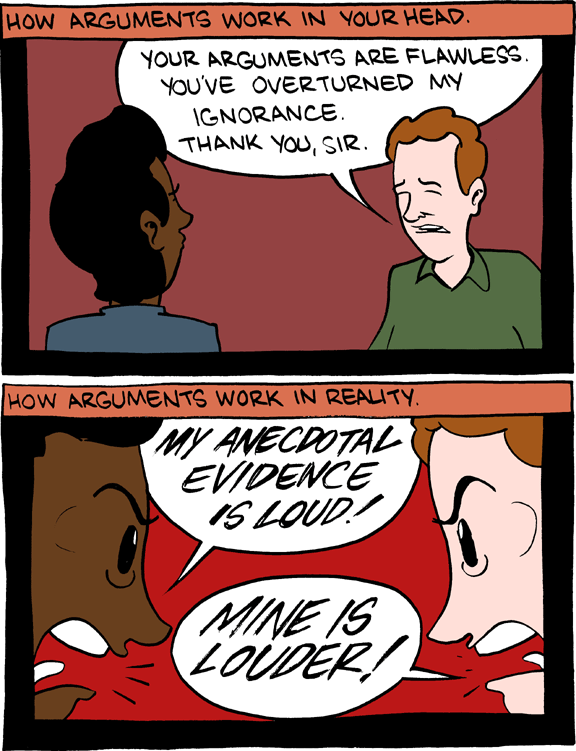
Rethinking Argument
We tend to make up our minds for emotional reasons. Then we identify with our conclusions, and find ourselves threatened or angry when someone tries to alter our conclusions. The more comfort we derive from our belief-based conclusion, the more fiercely we resist someone trying to change it.
Hence all the hostility amongst religions, or competing scientific theories.
We should be, at the very least, polite in our arguments -- and always have good, solid supporting evidence.
For politeness: How to Argue on the Internet and Linguistic Politeness Research Group
For good, solid arguments :

http://www.smbc-comics.com/
Hence all the hostility amongst religions, or competing scientific theories.
We should be, at the very least, polite in our arguments -- and always have good, solid supporting evidence.
For politeness: How to Argue on the Internet and Linguistic Politeness Research Group
For good, solid arguments :
http://www.smbc-comics.com/
Wednesday, July 13, 2011
Laughter As Philosophy - can it make us see reason?
This sounds to be a movie worth watching. I've looked at several interviews and clips; you can get links to more from youtube.
Bill Maher wants us to see that religion is created by humans to control other humans. As he says, 'no one knows'.
No one knows what happens when you die. Why would you accept the beliefs of someone who claims special knowledge? They're only human - just like you.
He hopes the rational 16% will stand up and be seen.
Maybe comedy will help. It certainly can't hurt.
Bill Maher wants us to see that religion is created by humans to control other humans. As he says, 'no one knows'.
No one knows what happens when you die. Why would you accept the beliefs of someone who claims special knowledge? They're only human - just like you.
He hopes the rational 16% will stand up and be seen.
Maybe comedy will help. It certainly can't hurt.
Tuesday, June 28, 2011
Why External Evaluation Really Helps
GrrlScientist often posts amazing stuff. Today was no exception.
I've been angsting over my comparative writing ability. I know - really stupid. After a certain technical competence is achieved, and a certain facility with words and style, it is so subjective.
But - this fascinated me. How do we assess ourselves, and others? How accurate are we in those assessments?
Interestingly, the less competent you are, the better you seem to think yourself. Competent people tend to over-rate others' performances, thus lessening their self-perceived skills.
Heartening conclusion: training and education - objective skills, do make us better at these judgements.
illusion of superiority
I've been angsting over my comparative writing ability. I know - really stupid. After a certain technical competence is achieved, and a certain facility with words and style, it is so subjective.
But - this fascinated me. How do we assess ourselves, and others? How accurate are we in those assessments?
Interestingly, the less competent you are, the better you seem to think yourself. Competent people tend to over-rate others' performances, thus lessening their self-perceived skills.
Heartening conclusion: training and education - objective skills, do make us better at these judgements.
illusion of superiority
Anger as Ink
What motivates us?
Compassion? Anger? Hate? Love?
What makes us want to keeping pushing, struggling to accomplish what needs to be done?
Life sets up more than sufficient obstacles. Just the every day work of surviving holds us in place, keeps us from reaching out too far towards what we want.
Other people hold us back. Not only out of spite or their needs, but simply because we are tied to them through so many types of bonds. But those bonds hold us to them, and thus back from what we want to become.
We set obstacles for ourselves: inertia, apathy, fear - oh yes, fear. The fear of failing, the fear of being laughed at - even the fear of succeeding. I want this. But what if I get it and I don't like it after all? Then what have I?
My biggest motivation seems to be anger. Initially at other people, then at the fool I am, but also at myself for believing I cannot do what I've set out to accomplish. For believing what others want me to believe rather than admitting, or even allowing hope of admitting what I know to be true about myself.
Anger is what forces me to realize that I am my own worst enemy. I cannot rest until I cause problems for myself, and then, when I've made enough of a mess, I can finally recognize it and start to clean it up.
The price is high. It is not a good way to accomplish your goals - alienating people, deliberately making problems for yourself. But if it increases the pressure enough that an explosion, however small, happens, then I suppose it's worth it. Anything to get out of despair and back into action.
Hopefully someday action will come without such finagling. Leaving a trail of self-destruction is not the best way to get out of a swamp and onto solid ground.
But to be angry at all is, for me, an amazing thing. It means I am finally learning that I don't have to bow my head and take blame for what others impose on me. I am not stuck. I can break out.
So anger becomes the ink to my pen. I can write, because I have to prove I am not incapable, not stupid, not such a fool as life, and the habits I've learned in life make me believe I am.
Having once done so, well, there's a whole world of new problems to face. But at least anger gives the energy to meet the challenge.
Compassion? Anger? Hate? Love?
What makes us want to keeping pushing, struggling to accomplish what needs to be done?
Life sets up more than sufficient obstacles. Just the every day work of surviving holds us in place, keeps us from reaching out too far towards what we want.
Other people hold us back. Not only out of spite or their needs, but simply because we are tied to them through so many types of bonds. But those bonds hold us to them, and thus back from what we want to become.
We set obstacles for ourselves: inertia, apathy, fear - oh yes, fear. The fear of failing, the fear of being laughed at - even the fear of succeeding. I want this. But what if I get it and I don't like it after all? Then what have I?
My biggest motivation seems to be anger. Initially at other people, then at the fool I am, but also at myself for believing I cannot do what I've set out to accomplish. For believing what others want me to believe rather than admitting, or even allowing hope of admitting what I know to be true about myself.
Anger is what forces me to realize that I am my own worst enemy. I cannot rest until I cause problems for myself, and then, when I've made enough of a mess, I can finally recognize it and start to clean it up.
The price is high. It is not a good way to accomplish your goals - alienating people, deliberately making problems for yourself. But if it increases the pressure enough that an explosion, however small, happens, then I suppose it's worth it. Anything to get out of despair and back into action.
Hopefully someday action will come without such finagling. Leaving a trail of self-destruction is not the best way to get out of a swamp and onto solid ground.
But to be angry at all is, for me, an amazing thing. It means I am finally learning that I don't have to bow my head and take blame for what others impose on me. I am not stuck. I can break out.
So anger becomes the ink to my pen. I can write, because I have to prove I am not incapable, not stupid, not such a fool as life, and the habits I've learned in life make me believe I am.
Having once done so, well, there's a whole world of new problems to face. But at least anger gives the energy to meet the challenge.
Saturday, June 11, 2011
Life, Cilantro, and Philosophy
I must issue a disclaimer.
I am not a philosopher.
I've taken quite a few philosophy courses. For several of those I was fortunate enough to have a professor whose chief concern was making us think, rather than memorizing dates and themes. It is no surprise, then, that the philosophy professor in my novel takes this approach to her basic classes: teach them to think, to understand how to frame an argument, to identify fallacy, and you have given them skills that will enhance their lives.
Life, to me, is about ideas. Glorious, inspiring, thought-provoking ideas. Comfortable or not, ideas spark what is unique in us – our thoughts and dreams.
Human thought and action are shaping the world. I come down fully on the side of naming this the Anthropocene. We are too powerful a force to be ignored, even geologically. And what we do is not always good for the present or the future. But as a species, we seem to be helpless against beliefs.
Beliefs and ideas are not the same. Some are working-valid. I believe that people should obey the law. The law says you do not allow religion in the schools. I believe that people who pray in school are criminals and should be held accountable as such. These are beliefs, but they are based on facts.
I also believe my cats are the most adorable creatures that ever lived. I know this is false. It is my opinion-belief. I can believe it if I wish, but I cannot, must not expect others to agree with me.
I know the difference between belief that is a personal opinion, and belief that is based on some evidence, and facts.
When I say 'I admire Bertrand Russell', this does not mean wholesale endorsement. Then I would be a Russell-ian, a follower rather than one who reads and thinks based upon what is read.
Following kills the mind. We need to learn to think. To question, analyze, and evaluate based on evidence, not authority.
When someone says, 'It's true. I read it in a book' they are admitting they aren't thinking for themselves. It doesn't matter what book it is – they are accepting dogma.
Now, if they say, 'It might be true. I read a report...' they are more likely to be thinking. First, they have qualified their statement, pending further proof. Second, they are reading reports, or studies, trying to get as close as they can to actual evidence. Third, they are not just reading the headlines, but the substance.
When I write about philosophy and writing, I am not issuing proclamations. I am offering connections I've seen, ideas that I've appreciated. You may, and almost certainly will see them differently.
And that is the beginning of dialogue – rational discussion of ideas. And that, to me, is the greatest joy in life.
Oh, the cilantro? Cilantro is like belief. A little bit can add spice to life. Too much, and it destroys everything else.
My evidence? Mostly anecdotal, I fear. Although I have read that cilantro is one of the love/hate flavors. Few people are neutral. Which makes me wonder why so many restaurants glop it into everything in great hulking handfuls... sorry.
Even a small amount of cilantro and I cannot taste anything else. I could be eating the most exquisite food in the world, and all I'd taste is that chalky, pungent (disgusting) flavor.
New tastes, new impressions, new ideas are too precious to miss.
I try not to be cilantro.
Subscribe to:
Posts (Atom)