This article is about two deaths. Two men, both artists, and how they faced early death.
One in dissolution and despair. One in awareness and creation.
Isn't this article really about how to live?
NPR's Krulwich Wonders
Showing posts with label denial. Show all posts
Showing posts with label denial. Show all posts
Thursday, November 3, 2011

Sunday, October 23, 2011
Anti-Intellectual Incompetence
An interesting post from Massimo Pigliucci at Rationally Speaking.
I was particularly intrigued because I had just read yet another 'discussion' on religion vs. science, where the arguers for religion were chronically unable to discern the difference between proof and belief. If one cannot make that very gaping distinction, there is no hope of discussion. I admit to feeling there is no need for discussion. Religion, in this so global modern world, should be private and personal, and ought not to be imposed on others. My beliefs are mine; theirs are theirs. But provable information -- that is the realm of the public domain.
This article discusses another false dichotomy: intellectualism vs engineers. Timothy Ferris of 'Wired Magazine' argues that only productive technology is worthwhile (does he work for Perry?) and that thinking, ideas, and intellectual processes are a waste of time.
How, I wonder, did he get the education that allowed him to think about this? Not that he did much thinking. It is clear he is bias-promotion rather than genuine reasoning in his article.
Massimo makes several good points, most notably that Ferris "makes his case by cherry picking examples, distorting history, and simply ignoring what is not convenient for his thesis." He provides examples to support this claim.
Later, Massimo says, "five minute of serious reflection should have made Ferris realize that he created a straw man with precious little correspondence to reality." Again, he offers counter arguments worth considering.
I am, as with religion vs science, willing to allow both sides validity. I see them as reflecting different aspects of human nature and need. I have always been grossly suspicious of any premise that requires absolute exclusive validity. Nature vs Nurture. Particle vs Wave. Life is seldom so clear cut. My guiding principle is 'it's a spectrum' and from that beginning, I proceed, cautiously, to determine how dark or light the shades of grey are on any issue.
Well worth reading: http://rationallyspeaking.blogspot.com/2011/10/engineers-vs-intellectuals-how-timothy.html
I was particularly intrigued because I had just read yet another 'discussion' on religion vs. science, where the arguers for religion were chronically unable to discern the difference between proof and belief. If one cannot make that very gaping distinction, there is no hope of discussion. I admit to feeling there is no need for discussion. Religion, in this so global modern world, should be private and personal, and ought not to be imposed on others. My beliefs are mine; theirs are theirs. But provable information -- that is the realm of the public domain.
This article discusses another false dichotomy: intellectualism vs engineers. Timothy Ferris of 'Wired Magazine' argues that only productive technology is worthwhile (does he work for Perry?) and that thinking, ideas, and intellectual processes are a waste of time.
How, I wonder, did he get the education that allowed him to think about this? Not that he did much thinking. It is clear he is bias-promotion rather than genuine reasoning in his article.
Massimo makes several good points, most notably that Ferris "makes his case by cherry picking examples, distorting history, and simply ignoring what is not convenient for his thesis." He provides examples to support this claim.
Later, Massimo says, "five minute of serious reflection should have made Ferris realize that he created a straw man with precious little correspondence to reality." Again, he offers counter arguments worth considering.
I am, as with religion vs science, willing to allow both sides validity. I see them as reflecting different aspects of human nature and need. I have always been grossly suspicious of any premise that requires absolute exclusive validity. Nature vs Nurture. Particle vs Wave. Life is seldom so clear cut. My guiding principle is 'it's a spectrum' and from that beginning, I proceed, cautiously, to determine how dark or light the shades of grey are on any issue.
Well worth reading: http://rationallyspeaking.blogspot.com/2011/10/engineers-vs-intellectuals-how-timothy.html
Monday, July 25, 2011
Writers Are Smart, and I'm Angry
I heard this in a conversation yesterday: "She's so stupid she can't even add 2 + 2. I told her to take Creative Writing courses instead of math."
I am not good with snappy comebacks, and even if I were, the social setting would have precluded responding. I didn't want to be seen as creating a scene*. Besides, I know from experience that the speaker would say, "I didn't mean it that way."
A long history with said speaker has shown that he may like to believe he doesn't mean it that way, but he keeps saying things like that. I am skeptical of his self-knowledge, to say the least.
And yes, he knows I am a writer.
An angry, not stupid writer.
Obviously, as in all things in life, there is a spectrum. There's some really bad writing floating about, and more is put out every day thanks to ebooks and self-publishing.
All that means is there's more to wade through to get to the gems.
It does not mean that all, or even most writers are bad. Or dumb. Or anything else. Any more than a small percentage of fundamentalist maniacs with murder on their brains means that religion is inherently violent, or that a few teenagers who get drunk means that all youth is doomed to alcoholism.
I spend an hour, often closer to two every day reading science, philosophy, psychology; trying to get background for my writing. I read writing blogs trying to understand options, processes, and changing procedures in publishing.
I write. And write. And write, and strive to improve with whatever input I can coax and beg out of anyone who'll read my words.
You don't need to be a math teacher to be smart. You don't need a degree in physics. You do need a questioning mind that is open to -- no, actively seeking new information and new ways to see the world. A good writer spends their life doing just that.
Writers are smart. Talented, determined, brave, and above all, people who can face more rejection, more isolation, more years without any positive feedback on their dreams than any other profession I can think of.
Twitter. #writersaresmart
I'm curious what you have to say in response to that offensive comment.
*why is it that when someone says or does something, it's always the person who takes them to task that's seen as 'causing a scene', and not the original offender?
I am not good with snappy comebacks, and even if I were, the social setting would have precluded responding. I didn't want to be seen as creating a scene*. Besides, I know from experience that the speaker would say, "I didn't mean it that way."
A long history with said speaker has shown that he may like to believe he doesn't mean it that way, but he keeps saying things like that. I am skeptical of his self-knowledge, to say the least.
And yes, he knows I am a writer.
An angry, not stupid writer.
Obviously, as in all things in life, there is a spectrum. There's some really bad writing floating about, and more is put out every day thanks to ebooks and self-publishing.
All that means is there's more to wade through to get to the gems.
It does not mean that all, or even most writers are bad. Or dumb. Or anything else. Any more than a small percentage of fundamentalist maniacs with murder on their brains means that religion is inherently violent, or that a few teenagers who get drunk means that all youth is doomed to alcoholism.
I spend an hour, often closer to two every day reading science, philosophy, psychology; trying to get background for my writing. I read writing blogs trying to understand options, processes, and changing procedures in publishing.
I write. And write. And write, and strive to improve with whatever input I can coax and beg out of anyone who'll read my words.
You don't need to be a math teacher to be smart. You don't need a degree in physics. You do need a questioning mind that is open to -- no, actively seeking new information and new ways to see the world. A good writer spends their life doing just that.
Writers are smart. Talented, determined, brave, and above all, people who can face more rejection, more isolation, more years without any positive feedback on their dreams than any other profession I can think of.
Twitter. #writersaresmart
I'm curious what you have to say in response to that offensive comment.
*why is it that when someone says or does something, it's always the person who takes them to task that's seen as 'causing a scene', and not the original offender?
Friday, July 22, 2011
What Would You Censor?
This is a great post from 'The Guardian' literary editor and blogger Claire Armitstead.
I enjoyed the comments, too, both the serious and the humorous. Way to go, Gogg. What a horrible thought that people should learn to read -- and, oh horrors! maybe even ask questions and think.
http://www.guardian.co.uk/books/booksblog/2011/jul/22/harmful-books-censor
I enjoyed the comments, too, both the serious and the humorous. Way to go, Gogg. What a horrible thought that people should learn to read -- and, oh horrors! maybe even ask questions and think.
http://www.guardian.co.uk/books/booksblog/2011/jul/22/harmful-books-censor
Friday, July 15, 2011
Rethinking Argument
We tend to make up our minds for emotional reasons. Then we identify with our conclusions, and find ourselves threatened or angry when someone tries to alter our conclusions. The more comfort we derive from our belief-based conclusion, the more fiercely we resist someone trying to change it.
Hence all the hostility amongst religions, or competing scientific theories.
We should be, at the very least, polite in our arguments -- and always have good, solid supporting evidence.
For politeness: How to Argue on the Internet and Linguistic Politeness Research Group
For good, solid arguments :

http://www.smbc-comics.com/
Hence all the hostility amongst religions, or competing scientific theories.
We should be, at the very least, polite in our arguments -- and always have good, solid supporting evidence.
For politeness: How to Argue on the Internet and Linguistic Politeness Research Group
For good, solid arguments :
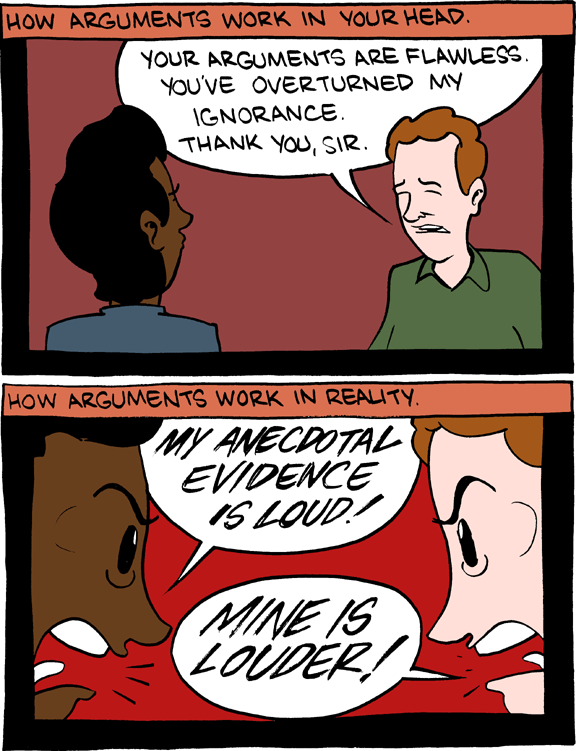
http://www.smbc-comics.com/
Wednesday, July 13, 2011
Laughter As Philosophy - can it make us see reason?
This sounds to be a movie worth watching. I've looked at several interviews and clips; you can get links to more from youtube.
Bill Maher wants us to see that religion is created by humans to control other humans. As he says, 'no one knows'.
No one knows what happens when you die. Why would you accept the beliefs of someone who claims special knowledge? They're only human - just like you.
He hopes the rational 16% will stand up and be seen.
Maybe comedy will help. It certainly can't hurt.
Bill Maher wants us to see that religion is created by humans to control other humans. As he says, 'no one knows'.
No one knows what happens when you die. Why would you accept the beliefs of someone who claims special knowledge? They're only human - just like you.
He hopes the rational 16% will stand up and be seen.
Maybe comedy will help. It certainly can't hurt.
Wednesday, June 22, 2011
Cracked, and Writing is Despair - when it's not elation
I was doing my morning's routine of reading comics, then blogs. Science, philosophy; and there's a few writing ones I like to follow. Though for writing I mostly use Twitter - a random idea jumps out and says "Here! This is what you've been needing to think about!" For which I am truly, truly grateful.
Anyways, on one of the philosophy blogs I followed a link and discovered that the book I've been working one for the last year is, apparently, a cheap flimsy watered-down version of the sort of novels some very famous (in the right circles) (which I obviously don't inhabit) (which is another point of despair) person has been writing for many years now.
All my hundreds of hours of research, my hundreds of hours of writing, my in progress hundreds of hours of editing - for what?
And I am sunk once again in inescapable gloom.
What's the point? I know I am not unique, that no one is unique, that every story has been told thousands of thousand of times... but I was feeling pretty good about my book up to that moment.
I used to be a very stable person. Not without upheavals, but generally rational, reasonable, and not prone to gloom.
Since becoming a writer, my life is the proverbial roller-coaster. And not with slow steady swings from elation to despair.
Oh no. That would be too easy. Like a toddler with a light switch my brain leaps from extreme to extreme, within the same bleeding sentence.
So then I find this: http://www.cracked.com/blog/how-to-become-author-in-5-incredibly-difficult-steps/
I don't know how I hadn't seen it before. Cracked is a wonderful place for researched information in a quirky, irreverent style.
Being able to laugh, even though being reminded yet again (and I didn't need the reminder - I never forget) that I am not in the tiniest bit unique, made me feel better.
And I will write today. How could I not? It is who I am, for good or ill.
Anyways, on one of the philosophy blogs I followed a link and discovered that the book I've been working one for the last year is, apparently, a cheap flimsy watered-down version of the sort of novels some very famous (in the right circles) (which I obviously don't inhabit) (which is another point of despair) person has been writing for many years now.
All my hundreds of hours of research, my hundreds of hours of writing, my in progress hundreds of hours of editing - for what?
And I am sunk once again in inescapable gloom.
What's the point? I know I am not unique, that no one is unique, that every story has been told thousands of thousand of times... but I was feeling pretty good about my book up to that moment.
I used to be a very stable person. Not without upheavals, but generally rational, reasonable, and not prone to gloom.
Since becoming a writer, my life is the proverbial roller-coaster. And not with slow steady swings from elation to despair.
Oh no. That would be too easy. Like a toddler with a light switch my brain leaps from extreme to extreme, within the same bleeding sentence.
So then I find this: http://www.cracked.com/blog/how-to-become-author-in-5-incredibly-difficult-steps/
I don't know how I hadn't seen it before. Cracked is a wonderful place for researched information in a quirky, irreverent style.
Being able to laugh, even though being reminded yet again (and I didn't need the reminder - I never forget) that I am not in the tiniest bit unique, made me feel better.
And I will write today. How could I not? It is who I am, for good or ill.
Thursday, June 2, 2011
Science and Uncertainty
Four posts today, all on the topics of what we think we know, what we actually do know, and how we go about distinguishing between the two. And having distinguished, what do we do about it?
First up, recognizing that uncertainty is not an excuse for ignoring probable danger. The context here is global climate change. There is enough evidence to know that the climate is warming. Even if it were entirely natural, we still need to be working hard on ways to minimize the disruption (gentle word) climate shift will cause. And yet the reaction is all too often complete denial (humorous take on argumentative reasoning here) or accepting it's happening, but not that it will cause problems. Neither response will help. Hence the phrase in Professor Juan Cole's post: "The Big Oil and Big Coal executives attempting to stop efforts to reduce emissions are thus in effect mass murderers of a future generation."
Read also Chris Mooney on uncertainty as a response.
Then there was a delightful post about established beliefs in science. Eventually testing wins over belief. That's why science improves the way we live and belief can't. Without science, we'd all be living in caves eating raw food and dying of simple injuries and diseases. But we'd have our beliefs! Such a comfort. The first hand account by Mpemba is a joy to read. And I loved footnote six. Finding observational information in all sorts of strange places.
Last is a distressing post about how we alter our own behavior to fit perceived stereotypes about ourselves. Apparently the ruling bodies of the Educational Testing Services want to keep women and minorities out of higher education? (don't sue me - change your testing!)
First up, recognizing that uncertainty is not an excuse for ignoring probable danger. The context here is global climate change. There is enough evidence to know that the climate is warming. Even if it were entirely natural, we still need to be working hard on ways to minimize the disruption (gentle word) climate shift will cause. And yet the reaction is all too often complete denial (humorous take on argumentative reasoning here) or accepting it's happening, but not that it will cause problems. Neither response will help. Hence the phrase in Professor Juan Cole's post: "The Big Oil and Big Coal executives attempting to stop efforts to reduce emissions are thus in effect mass murderers of a future generation."
Read also Chris Mooney on uncertainty as a response.
Then there was a delightful post about established beliefs in science. Eventually testing wins over belief. That's why science improves the way we live and belief can't. Without science, we'd all be living in caves eating raw food and dying of simple injuries and diseases. But we'd have our beliefs! Such a comfort. The first hand account by Mpemba is a joy to read. And I loved footnote six. Finding observational information in all sorts of strange places.
Last is a distressing post about how we alter our own behavior to fit perceived stereotypes about ourselves. Apparently the ruling bodies of the Educational Testing Services want to keep women and minorities out of higher education? (don't sue me - change your testing!)
Subscribe to:
Posts (Atom)