This is a great post from 'The Guardian' literary editor and blogger Claire Armitstead.
I enjoyed the comments, too, both the serious and the humorous. Way to go, Gogg. What a horrible thought that people should learn to read -- and, oh horrors! maybe even ask questions and think.
http://www.guardian.co.uk/books/booksblog/2011/jul/22/harmful-books-censor
Friday, July 22, 2011

Wednesday, July 20, 2011
More Than Merely Literary Fiction
I still puzzle over what differentiates literary from genre.
"I know it when I see it" is so often the final definition. Character driven, high-minded, complex, many layered.
I love this definition: "Work of great sensibility and refinement, where it can take up to 500 pages for nothing to happen." from Frank Baron
In the end, it is, like almost everything in life, a spectrum. There are books that are genre, no question. There are books that are literary, equally without question.
But all along the way, there are books whose ideas, whose writing style, whose detailed evocation of place, mood,or character are so eloquent that, even though there is a romance, or a crime, or an alien invasion, they are also literary.
Over and over we read that everything in the story must move the story forward. Every scene must fill at least two roles: establishing motivation, explaining necessary backstory, revealing character, and so on.
Perhaps part of the difference, then, is that in literary fiction, you have greater latitude in how much you reveal or the pace at which you move the story forward.
In literary fiction, you can have, as in "The Life of Pi", paragraphs of imagery and impressions that serve to create the mood of the story and the way in which the character views the world that in a genre book would be considered too slow. "Tighten it up" I hear an editor cry. "You'll lose your readers' interest."
And you would, if they were reading it as a detective story or a romance story. But when the book aspires to be something besides -- note - not more than -- science fiction or thriller; when the writer wants to draw you into a world or a state of mind; then you are entering the world of literary fiction.
And we are left again with personal preference. I might read it and see it as a literary fantasy. You might read it and see it as fantasy only.
This is part of why I favor the label Speculative Fiction. It allows the idea that elements of fantasy or science fiction are not the absolute arbiter of the story's classification. A space ship can carry the tragedy of Hamlet in its crew, and a mystery can encompass the eternal question of what it means to be human.
I could wish that we weren't so determined to make arbitrary distinctions. I realize that, like standardized testing in the schools, there are times we need to stick labels on things. But if we are interested in understanding what books have to offer, then we need to look past the labels publishers and booksellers require and accept a book on its individual nature.
Any time we break down barriers, we are enriching our world.
Monday, July 18, 2011
Another Round of Sympathetic Insecurity
I've found several comics that accurately reflect the potential, and often realized insecurity of artistic endeavors.
This is the most recent one:
 (click to enlarge)
http://www.calamitiesofnature.com/archive/560.jpg
This is the most recent one:

http://www.calamitiesofnature.com/archive/560.jpg
Friday, July 15, 2011
Rethinking Argument
We tend to make up our minds for emotional reasons. Then we identify with our conclusions, and find ourselves threatened or angry when someone tries to alter our conclusions. The more comfort we derive from our belief-based conclusion, the more fiercely we resist someone trying to change it.
Hence all the hostility amongst religions, or competing scientific theories.
We should be, at the very least, polite in our arguments -- and always have good, solid supporting evidence.
For politeness: How to Argue on the Internet and Linguistic Politeness Research Group
For good, solid arguments :

http://www.smbc-comics.com/
Hence all the hostility amongst religions, or competing scientific theories.
We should be, at the very least, polite in our arguments -- and always have good, solid supporting evidence.
For politeness: How to Argue on the Internet and Linguistic Politeness Research Group
For good, solid arguments :
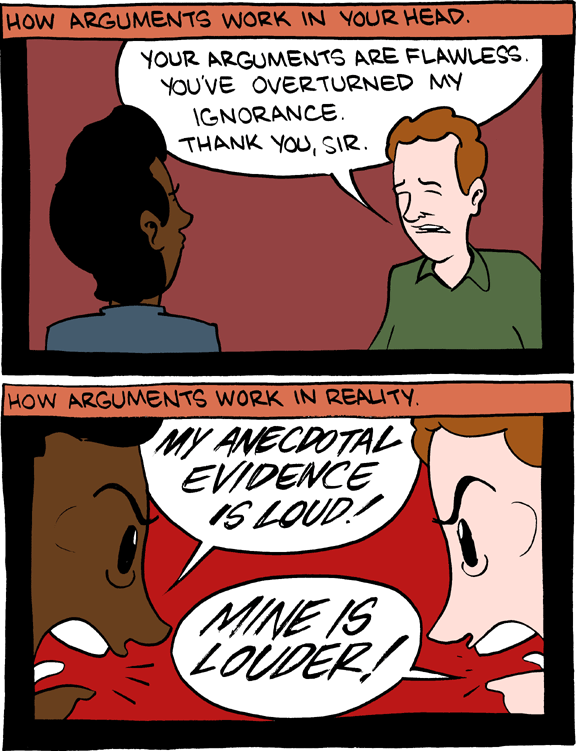
http://www.smbc-comics.com/
Thursday, July 14, 2011
Your Work Lacks Confidence
Oh dear. I feel like this all too often. It is annoying.
 http://www.savagechickens.com/wp-content/uploads/chickencrapart.jpg

Wednesday, July 13, 2011
Laughter As Philosophy - can it make us see reason?
This sounds to be a movie worth watching. I've looked at several interviews and clips; you can get links to more from youtube.
Bill Maher wants us to see that religion is created by humans to control other humans. As he says, 'no one knows'.
No one knows what happens when you die. Why would you accept the beliefs of someone who claims special knowledge? They're only human - just like you.
He hopes the rational 16% will stand up and be seen.
Maybe comedy will help. It certainly can't hurt.
Thursday, July 7, 2011
Creating Real Worlds and Real Characters
This post,'The fallacy of difference, in science and art', puts a proper label on something I've been mulling over for a long time.
Fallacy of Difference.
We focus on what's unique, or defining, and forget commonality.
A character whose defining attribute for my story is her supportive role for the protagonist is still a real person. I ask myself, not "what would a supporting character do?" but rather, "What would Sara do?", because she is real to me. But I see where I have failed to create this reality in other characters.
It holds for settings, for ideas, for plot. Nothing should be defined by its uniqueness. That is one dimensional. Strive instead for facets that reflect points of view. Create a virtual reality or a hologram, not a flat, static image.
Three dimensional writing - no, has to be four. Time, and the changes time brings are essential in life and in art.
Subscribe to:
Posts (Atom)