
Saturday, June 23, 2012
Not Chocolate?
So many things I enjoy - and it all comes down to this. Not sure whether to be sad or elated - and even then it's still only serotonin and dopamine.


Tuesday, April 17, 2012

Wednesday, March 28, 2012
Thoroughly Conscious Ignorance
"Science becomes a series of elegant puzzles and puzzles within puzzles—and who doesn’t like puzzles?"
This is absolutely right. The thrill of contemplating everything we can learn. Yes, I love to learn what is known, but it inspires me to realize that everything we learn means there's more to explore.
This is absolutely right. The thrill of contemplating everything we can learn. Yes, I love to learn what is known, but it inspires me to realize that everything we learn means there's more to explore.
Or, to quote a less 'technical' source, "The world is so full of a number of things / I'm sure we should all be as happy as kings."
From Scientific American, "What Science Wants to Know"
Monday, March 19, 2012
Monday, January 16, 2012
There, There. It's All Right ....
I keep clicking. My perceptions of objective reality obviously need new settings.
http://make-everything-ok.com/
http://make-everything-ok.com/
Saturday, January 14, 2012
Scientific Reality
If only it were so simple. This applies to writing, too. But there it's known as editing, revising, rewriting, more editing, more revising ....


Tuesday, January 3, 2012
Kindle Is For Books?
"Certainly a book isn't something I would ever want. Nor would I want one, electronic or otherwise, near my kids."
From The Daily Mash: Britain desperately trying to download games onto Kindle
From The Daily Mash: Britain desperately trying to download games onto Kindle
Saturday, December 31, 2011
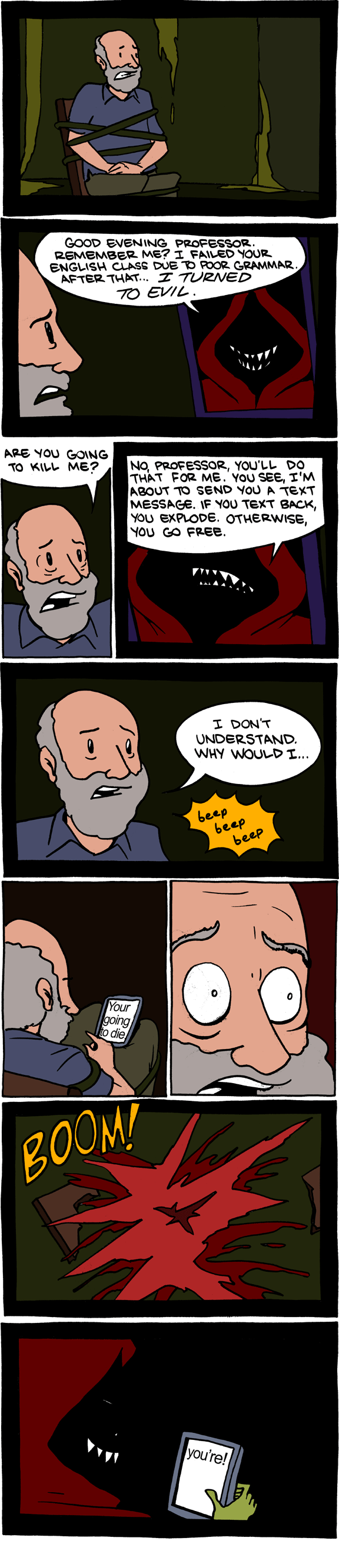
Oh! This is So Evil
What a nefarious scheme. One that could not fail.
 http://www.smbc-comics.com/comics/20111231.gif
Monday, December 5, 2011
Mirrors
Mirrors are odd things. They're how we see ourselves, but it's a reversed seeing. Yet they're perhaps the most common way we know to visualize ourselves.
If I tell myself to touch the right side of my face, my hand goes up to touch my cheek. No problem. But looking in a mirror, touching the right side of my mirror-face, the hand wants to cross over.
It's as if my image were another person; that would be their right side. So what I see in the mirror is a perceptual mix of myself and an imagined 'other person' looking at me.
We see bits and pieces of ourselves in mirrors. I can brush my teeth before a mirror and come away with no idea whether or not my hair is tidy. I can see what I want to see to some degree. It becomes trickery to allow myself to see my image without that filter.
Such an odd thing to see yourself in a mirror unexpectedly. For a sharp moment you see a stranger. For an instant, you see yourself as others see you. Then the filters kick in and you see you.
Such honesty can be hard to bear, either from mirrors or from other people.
People are mirrors for one another. We mimic words and gestures of those we get close to, even of strangers. We are influenced by the moods written in their faces, their gestures, their voices.
We see how other people act. If we admire it, we want to take it in and reflect it back from ourselves. Smiling makes us feel happier. Acting strong changes our hormones and makes us strong. We can make ourselves to be more as we wish to be. Mirroring others is part of that process.
Friends reveal so much of who you are. Who are they when they're with you? Long term relationships can become reflections of reflections, both of you mirroring long-past conceptions or stages with perhaps no validity in the present. Habits. If you disrupt the reflections you fragment the relationship.
This can be good. It lets you both see one another as who you are, not who you are in your interpreted reflections of one another. But it can also mean that instead of a friend you see a stranger, and all you share now are those long-established mutually reflecting images.
A friend who reflects you truly – why does that happen? It can be hard to bear, to have to be honest with them and with yourself. It is also liberating. If they're still around after that honesty, they truly are a friend.
Friendship. Seeing another person for who they are, not who you want / need them to be. Taking what is weak or unkind in them and holding it in gentle hands, helping them accept and improve that part of themselves. Recognizing what is noble and wise in them and honoring that, taking it into yourself and giving it back to them with humility and gratitude. Giving them the joy of loving them for all those facets, not just for the few you like best.
Letting them love who you are, too.
Wednesday, November 30, 2011
A Book's Nightmare
Authors long for 'the movie deal', but how many are pleased with the results?
 http://zs1.smbc-comics.com/comics/20111130.gif

Saturday, November 12, 2011
Alan Garner on Alan Turing
Since I first learned of Alan Turing I have been outraged at what was done to him. A comfortable outrage, I now realize. Intellectual. From a safe distance.
No longer.
A blow to the stomach -- a shock wave shattering my complacent sanctimony into bitter fragments of self-understanding and horror.
Alan Garner's simple, short biographical statement does more to show evil in the guise of morality than any epistle or sermon ever could.
This is what writing can do.
He was stocky, barrel-chested, with a high-pitched, donnish voice and the aerodynamics of a brick. He was funny and witty and he talked endlessly, but I understood very little of what he was saying, and it became clear that he ran in order to think. He seemed to be obsessed by mathematics and biology. That much I could work out.
We had one thing in common: a fascination with Disney's Snow White and the Seven Dwarfs, especially the transformation of the Wicked Queen into the Witch. He used to go over the scene in detail, dwelling on the ambiguity of the apple, red on one side, green on the other, one of which gave death. We had both been traumatised by Walt.
On one occasion he asked me whether, in my opinion as a classical linguist, artificial intelligence was possible. After a couple of miles of silence I said that, in my opinion, it was not. And that was that.
He killed himself when an ignorant and uncouth judge gave him the choice of a prison sentence or chemical castration; and I was overwhelmed by fury at the salacious, gloating humiliation imposed on my friend, and by a sense of guilt that I did not, could not, help him; which lasted for decades, and was made only worse when the Official Secrets Act revealed his true heroism.
He died of cyanide poisoning. By his body was an apple, partly eaten. The apple was not tested for cyanide. His name was Alan Turing.
http://www.guardian.co.uk/books/2011/nov/11/alan-turing-my-hero-alan-garner
No longer.
A blow to the stomach -- a shock wave shattering my complacent sanctimony into bitter fragments of self-understanding and horror.
Alan Garner's simple, short biographical statement does more to show evil in the guise of morality than any epistle or sermon ever could.
This is what writing can do.
My hero: Alan Turing, by Alan Garner
In the 1950s I was an athlete. Those were the days before joggers clogged the highway, so it was unusual for me to see another runner when I was training. We fell into the habit of meeting up and pounding the miles together for company.He was stocky, barrel-chested, with a high-pitched, donnish voice and the aerodynamics of a brick. He was funny and witty and he talked endlessly, but I understood very little of what he was saying, and it became clear that he ran in order to think. He seemed to be obsessed by mathematics and biology. That much I could work out.
We had one thing in common: a fascination with Disney's Snow White and the Seven Dwarfs, especially the transformation of the Wicked Queen into the Witch. He used to go over the scene in detail, dwelling on the ambiguity of the apple, red on one side, green on the other, one of which gave death. We had both been traumatised by Walt.
On one occasion he asked me whether, in my opinion as a classical linguist, artificial intelligence was possible. After a couple of miles of silence I said that, in my opinion, it was not. And that was that.
He killed himself when an ignorant and uncouth judge gave him the choice of a prison sentence or chemical castration; and I was overwhelmed by fury at the salacious, gloating humiliation imposed on my friend, and by a sense of guilt that I did not, could not, help him; which lasted for decades, and was made only worse when the Official Secrets Act revealed his true heroism.
He died of cyanide poisoning. By his body was an apple, partly eaten. The apple was not tested for cyanide. His name was Alan Turing.
http://www.guardian.co.uk/books/2011/nov/11/alan-turing-my-hero-alan-garner
Thursday, November 10, 2011

Thursday, November 3, 2011
How to Die?
This article is about two deaths. Two men, both artists, and how they faced early death.
One in dissolution and despair. One in awareness and creation.
Isn't this article really about how to live?
NPR's Krulwich Wonders
One in dissolution and despair. One in awareness and creation.
Isn't this article really about how to live?
NPR's Krulwich Wonders
Tuesday, November 1, 2011
Sunday, October 30, 2011
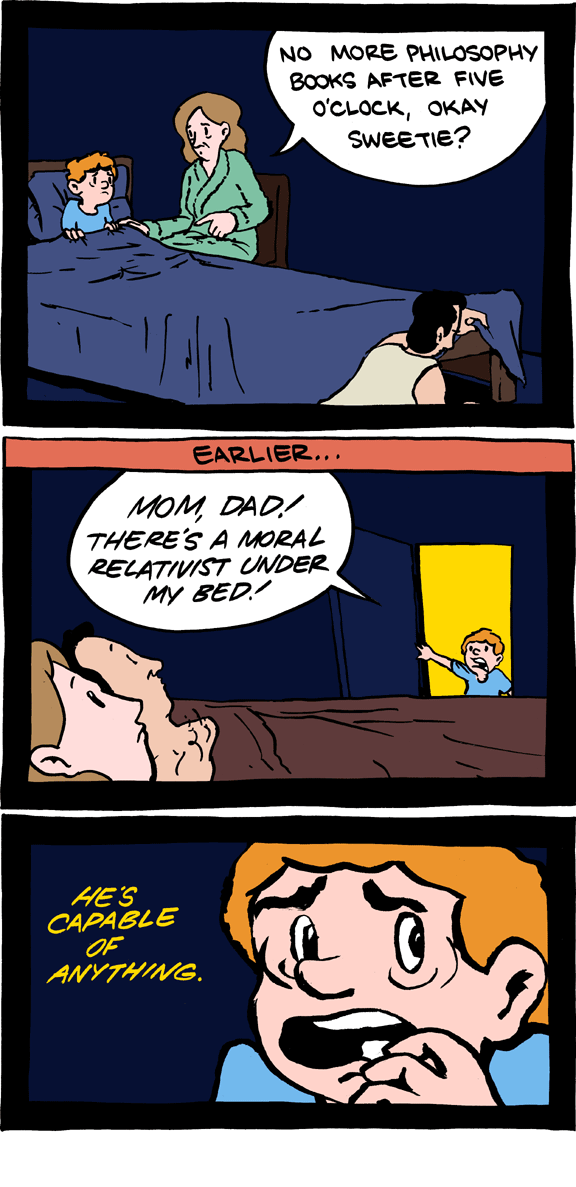
Kids or Spouse?

A friend and I had just been discussing this question. We wondered how many other women question this. Of course, there's two sides to the question: kids and no spouse, or spouse and no kids. Either way, society often frowns.
I'm thinking a lot about cultural myths lately. Tradition dictates marriage and family. But in this as in all things, people should be free to choose -- and most importantly, society should support those choices. It's all too easy to feel guilty for wanting a non-traditional life.
Then I think about choices that are even more non-traditional, and I am once again humbled at the courage people have, who choose not to hide who they are: different sexual orientations, gender change, even (omg) atheists.
We are getting better, I think, as a society, but there's still so much intolerance, even hatred for those who don't abide by a perceived norm. But what is normal, and why? And who decides?
I think it's easier on everyone to stop insisting we have the right to tell others how to live, and ask instead for respect. Be kind. That's all.
http://www.arcamax.com/newspics/28/2805/280589.jpg
Saturday, October 29, 2011
I know I'm a Writer Because ....
I've read the quotes. 'unhappy is the house where a writer lives' sorts of things. I don't know about unhappy, but a writer does live here.
I am not a person who writes. I am a writer.
I know this because my deepest, most soul-stirring or harrowing emotions are greeted with a rapturous: "Oh cool! Now if I can just get this into words, I can use it in a story!"
I am not a person who writes. I am a writer.
I know this because my deepest, most soul-stirring or harrowing emotions are greeted with a rapturous: "Oh cool! Now if I can just get this into words, I can use it in a story!"
Tuesday, October 25, 2011
Anoesis: How New Words Open New Worlds
Yesterday morning I learned a new word. Such a delight (thanks to word of the day). There are words that I feel the lack of. One is a word for the deliberate act of ignoring. If I say ignorance, (IG-nor-ance) it means I don't know. But I want a word for ig-NOR-ance. Humans are very good at deliberately ignoring things, so why is there no word for it?
Yesterday's treasure was Anoesis: being flooded with emotion or sensation, and unable to form rational thought about it. And the most peculiar thing happened. That afternoon I was plunged into anoesis.
I love to analyze, and having a label for that abstract, overwhelming, compelling state helped. Of course, I was trying to find a way to express this state of being so I could use it in a novel, but also to help me understand why I felt that way.
Like the apparent duality in physics, I live in a Newtonian world. My still-enduring moment of anoesis plunged me into a Quantum universe where all I know and think is altered, pulsing to different energies and perceptions. The quantum universe underlies all I think I know. I, too, am looking for a grand unification of what I am and what I seem to be.
Words are not dangerous things, but they do foment revolutions, personal or global.
Yesterday's treasure was Anoesis: being flooded with emotion or sensation, and unable to form rational thought about it. And the most peculiar thing happened. That afternoon I was plunged into anoesis.
I love to analyze, and having a label for that abstract, overwhelming, compelling state helped. Of course, I was trying to find a way to express this state of being so I could use it in a novel, but also to help me understand why I felt that way.
Like the apparent duality in physics, I live in a Newtonian world. My still-enduring moment of anoesis plunged me into a Quantum universe where all I know and think is altered, pulsing to different energies and perceptions. The quantum universe underlies all I think I know. I, too, am looking for a grand unification of what I am and what I seem to be.
Words are not dangerous things, but they do foment revolutions, personal or global.
Sunday, October 23, 2011
Anti-Intellectual Incompetence
An interesting post from Massimo Pigliucci at Rationally Speaking.
I was particularly intrigued because I had just read yet another 'discussion' on religion vs. science, where the arguers for religion were chronically unable to discern the difference between proof and belief. If one cannot make that very gaping distinction, there is no hope of discussion. I admit to feeling there is no need for discussion. Religion, in this so global modern world, should be private and personal, and ought not to be imposed on others. My beliefs are mine; theirs are theirs. But provable information -- that is the realm of the public domain.
This article discusses another false dichotomy: intellectualism vs engineers. Timothy Ferris of 'Wired Magazine' argues that only productive technology is worthwhile (does he work for Perry?) and that thinking, ideas, and intellectual processes are a waste of time.
How, I wonder, did he get the education that allowed him to think about this? Not that he did much thinking. It is clear he is bias-promotion rather than genuine reasoning in his article.
Massimo makes several good points, most notably that Ferris "makes his case by cherry picking examples, distorting history, and simply ignoring what is not convenient for his thesis." He provides examples to support this claim.
Later, Massimo says, "five minute of serious reflection should have made Ferris realize that he created a straw man with precious little correspondence to reality." Again, he offers counter arguments worth considering.
I am, as with religion vs science, willing to allow both sides validity. I see them as reflecting different aspects of human nature and need. I have always been grossly suspicious of any premise that requires absolute exclusive validity. Nature vs Nurture. Particle vs Wave. Life is seldom so clear cut. My guiding principle is 'it's a spectrum' and from that beginning, I proceed, cautiously, to determine how dark or light the shades of grey are on any issue.
Well worth reading: http://rationallyspeaking.blogspot.com/2011/10/engineers-vs-intellectuals-how-timothy.html
I was particularly intrigued because I had just read yet another 'discussion' on religion vs. science, where the arguers for religion were chronically unable to discern the difference between proof and belief. If one cannot make that very gaping distinction, there is no hope of discussion. I admit to feeling there is no need for discussion. Religion, in this so global modern world, should be private and personal, and ought not to be imposed on others. My beliefs are mine; theirs are theirs. But provable information -- that is the realm of the public domain.
This article discusses another false dichotomy: intellectualism vs engineers. Timothy Ferris of 'Wired Magazine' argues that only productive technology is worthwhile (does he work for Perry?) and that thinking, ideas, and intellectual processes are a waste of time.
How, I wonder, did he get the education that allowed him to think about this? Not that he did much thinking. It is clear he is bias-promotion rather than genuine reasoning in his article.
Massimo makes several good points, most notably that Ferris "makes his case by cherry picking examples, distorting history, and simply ignoring what is not convenient for his thesis." He provides examples to support this claim.
Later, Massimo says, "five minute of serious reflection should have made Ferris realize that he created a straw man with precious little correspondence to reality." Again, he offers counter arguments worth considering.
I am, as with religion vs science, willing to allow both sides validity. I see them as reflecting different aspects of human nature and need. I have always been grossly suspicious of any premise that requires absolute exclusive validity. Nature vs Nurture. Particle vs Wave. Life is seldom so clear cut. My guiding principle is 'it's a spectrum' and from that beginning, I proceed, cautiously, to determine how dark or light the shades of grey are on any issue.
Well worth reading: http://rationallyspeaking.blogspot.com/2011/10/engineers-vs-intellectuals-how-timothy.html
Sunday, October 2, 2011
Pitch Puzzles -or- Jane Austen in Twenty-Five Words
I read about a pitch opportunity on the blog Help! I need a Publisher.
Twenty-five words to hook a reader onto your story. Not at all easy. I wonder if it helps if one's story is dramatic as opposed to thoughtful? Certainly some of the pitches in the comments were catchy -- well written, but also full of interesting premises and exciting events.
So what if you're writing about normal people living normal lives in normal ways, with no supernatural beings, no murders, no abusive family-members: then what?
I started wondering, how would I pitch Jane Austen -- any Jane Austen, in twenty-five words?
Feisty young woman tangles with arrogant man. Both mature, and despite family upheavals and conflicts, romance follows.
Quiet woman finds lost love again, but has he forgiven her past rejection? Family conflicts, scheming plots, but steadfast love wins all.
Two sisters exemplify reason and emotion, and both learn that a balance between the two is the key to love and life.
Okay -- I've gotten a bit silly. Sorry. In order, they were 'Pride and Prejudice', 'Persuasion', and 'Sense and Sensibility'. I didn't use my word quotas, so I could flesh them out a bit -- these ideas were off the top of my head.
The problem for me is that what sets these stories apart is not the basic plot, which sounds like a simple romance novel, but the development of the characters. "Both mature". They do. Both Elizabeth and Darcy are very different people by the end of the novel, and that is what's compelling: the people she creates and the interactions between them.
So my puzzle is, how do you pitch character development? Ideas, anyone?
Twenty-five words to hook a reader onto your story. Not at all easy. I wonder if it helps if one's story is dramatic as opposed to thoughtful? Certainly some of the pitches in the comments were catchy -- well written, but also full of interesting premises and exciting events.
So what if you're writing about normal people living normal lives in normal ways, with no supernatural beings, no murders, no abusive family-members: then what?
I started wondering, how would I pitch Jane Austen -- any Jane Austen, in twenty-five words?
Feisty young woman tangles with arrogant man. Both mature, and despite family upheavals and conflicts, romance follows.
Quiet woman finds lost love again, but has he forgiven her past rejection? Family conflicts, scheming plots, but steadfast love wins all.
Two sisters exemplify reason and emotion, and both learn that a balance between the two is the key to love and life.
Okay -- I've gotten a bit silly. Sorry. In order, they were 'Pride and Prejudice', 'Persuasion', and 'Sense and Sensibility'. I didn't use my word quotas, so I could flesh them out a bit -- these ideas were off the top of my head.
The problem for me is that what sets these stories apart is not the basic plot, which sounds like a simple romance novel, but the development of the characters. "Both mature". They do. Both Elizabeth and Darcy are very different people by the end of the novel, and that is what's compelling: the people she creates and the interactions between them.
So my puzzle is, how do you pitch character development? Ideas, anyone?
Thursday, September 29, 2011
Naming Your Characters
I started a writing course at the university this week. Still hoping to learn what is literature versus literary genre. Ideas? Writing style? Doom and gloom?
Hopefully I will learn. I've already learned they use a different jargon. For example, workshop = critique.
My first assignment was a very short (2/3 - 3/4 page single space) story on an assigned prompt. That was a challenge. I always have lots of ideas I want to write about, and it's been many years since I've been told what my topic must be.
I needed a name for the second character -- a name that reflected a certain, not innocence, but goodness. Argh. I finally used my default name of Jane, thinking I'd change it later when inspiration struck. It didn't, so it's printed now with Jane.
How do you choose characters' names? Very tricky, although sometimes inspiration does help.

http://www.arcamax.com/newspics/26/2605/260562.gif
UPDATE: Sunday's comic on the same theme:
 http://www.arcamax.com/newspics/26/2650/265083.gif
Hopefully I will learn. I've already learned they use a different jargon. For example, workshop = critique.
My first assignment was a very short (2/3 - 3/4 page single space) story on an assigned prompt. That was a challenge. I always have lots of ideas I want to write about, and it's been many years since I've been told what my topic must be.
I needed a name for the second character -- a name that reflected a certain, not innocence, but goodness. Argh. I finally used my default name of Jane, thinking I'd change it later when inspiration struck. It didn't, so it's printed now with Jane.
How do you choose characters' names? Very tricky, although sometimes inspiration does help.

http://www.arcamax.com/newspics/26/2605/260562.gif
UPDATE: Sunday's comic on the same theme:

Subscribe to:
Posts (Atom)