
Showing posts with label research. Show all posts
Showing posts with label research. Show all posts
Tuesday, April 17, 2012

Wednesday, March 28, 2012
Thoroughly Conscious Ignorance
"Science becomes a series of elegant puzzles and puzzles within puzzles—and who doesn’t like puzzles?"
This is absolutely right. The thrill of contemplating everything we can learn. Yes, I love to learn what is known, but it inspires me to realize that everything we learn means there's more to explore.
This is absolutely right. The thrill of contemplating everything we can learn. Yes, I love to learn what is known, but it inspires me to realize that everything we learn means there's more to explore.
Or, to quote a less 'technical' source, "The world is so full of a number of things / I'm sure we should all be as happy as kings."
From Scientific American, "What Science Wants to Know"
Monday, March 19, 2012
Tuesday, August 16, 2011
Pronouns and Word Choice Reveal Gender, Rank, and Intelligence
One reads posts analyzing how to write a male character, or how to write a female character. I often find myself irritated -- women have to have lots of friends, they have to be emotional, they have to care about dressing up, and they have to think men are uncommunicative. Men have to be taciturn, talk about football, have only one or two close friends (to whom they speak in occasional grunts), and they have to think women are irrational.
In reality, some women are sports-mad and some like fluffy little dogs. Some men are sharp dressers and some like fishing alone for hours.
But this article from Scientific American has real advice on writing relationships. Chose your pronouns carefully, writers. They can reflect gender, social rank, and intelligence.
Although we never notice it, when analyzed our speech patterns and writing show that women are far more likely than men to use cognitive words (e.g., because, reason, think, believe); social words (e.g., he, she, friend, cousin); and 1st person singular (I, me, my).
Men use articles more than women: (a, an, the).
According to Psychologist James Pennebaker, "men and women use language differently because they negotiate their worlds differently. Across dozens and dozens of studies, women tend to talk more about other human beings. Men, on the other hand, are more interested in concrete objects and things. To talk about human relationships requires social and cognitive words. To talk about concrete objects, you need concrete nouns which typically demand the use of articles."
Also, people of lower rank use "I" words in communications, whereas higher rank people avoid them.
These offer new ways to look at characterization. Although in reality we are unaware of these cues, if we write them into our characters, mightn't it make the reader's perception of their roles more vivid?
It's not just gender. This fascinated me:
"Higher GPAs were associated with admission essays that used high rates of nouns and low rates of verbs and pronouns. The effects were surprisingly strong and lasted across all years of college, no matter what the students’ major.
To me, the use of nouns -- especially concrete nouns -- reflects people’s attempts to categorize and name objects, events, and ideas in their worlds. The use of verbs and pronouns typically occur when people tell stories. Universities clearly reward categorizers rather than story tellers. If true, can we train young students to categorize more? Alternatively, are we relying too much on categorization strategies in American education?"
As I growled about a few posts back, writers can be seen by more analytic minds as being of inferior intelligence -- something that also plagues women in the eyes of some men. Emotional, social, story-telling minds are less valued than analytic, concrete minds.
Why?
I would argue both are important, and are equally essential to our human existence. Without the story tellers and the emotion-givers, we are robots. Without analysis and concrete reality, we are adrift without reason.
I am intrigued, and anxious to try gender-pronouns and concrete versus emotional in my stories.
How do you write? How do you tell a story that reflects the concrete? Do you have special cues you use for gender and rank? I'd love to read about them.
In reality, some women are sports-mad and some like fluffy little dogs. Some men are sharp dressers and some like fishing alone for hours.
But this article from Scientific American has real advice on writing relationships. Chose your pronouns carefully, writers. They can reflect gender, social rank, and intelligence.
Although we never notice it, when analyzed our speech patterns and writing show that women are far more likely than men to use cognitive words (e.g., because, reason, think, believe); social words (e.g., he, she, friend, cousin); and 1st person singular (I, me, my).
Men use articles more than women: (a, an, the).
According to Psychologist James Pennebaker, "men and women use language differently because they negotiate their worlds differently. Across dozens and dozens of studies, women tend to talk more about other human beings. Men, on the other hand, are more interested in concrete objects and things. To talk about human relationships requires social and cognitive words. To talk about concrete objects, you need concrete nouns which typically demand the use of articles."
Also, people of lower rank use "I" words in communications, whereas higher rank people avoid them.
These offer new ways to look at characterization. Although in reality we are unaware of these cues, if we write them into our characters, mightn't it make the reader's perception of their roles more vivid?
It's not just gender. This fascinated me:
"Higher GPAs were associated with admission essays that used high rates of nouns and low rates of verbs and pronouns. The effects were surprisingly strong and lasted across all years of college, no matter what the students’ major.
To me, the use of nouns -- especially concrete nouns -- reflects people’s attempts to categorize and name objects, events, and ideas in their worlds. The use of verbs and pronouns typically occur when people tell stories. Universities clearly reward categorizers rather than story tellers. If true, can we train young students to categorize more? Alternatively, are we relying too much on categorization strategies in American education?"
As I growled about a few posts back, writers can be seen by more analytic minds as being of inferior intelligence -- something that also plagues women in the eyes of some men. Emotional, social, story-telling minds are less valued than analytic, concrete minds.
Why?
I would argue both are important, and are equally essential to our human existence. Without the story tellers and the emotion-givers, we are robots. Without analysis and concrete reality, we are adrift without reason.
I am intrigued, and anxious to try gender-pronouns and concrete versus emotional in my stories.
How do you write? How do you tell a story that reflects the concrete? Do you have special cues you use for gender and rank? I'd love to read about them.
Wednesday, August 3, 2011
Sooty, Science, and Writing Backwards
I'm still struggling with the desire to get back to editing. Who knew it could be so seductive? But I need to keep to my goal, too.
This is not arbitrary. I need some sense of accomplishment, some goal I have attained. The editing -- who knows how long that will go on? After I work through all the notes I've made of things to add, clarify, or rewrite, I need to go over the work as a whole. Then it gets bundled off to my long-suffering editor. Then back to me for who knows how much more work.
Sooty, though, I am treating as an experiment. Yes, I want a good novel. Yes, I must be proud of it or I won't put it out. But I'm trying to learn necessary skills by doing them, not by reading about how to do them. Applying intellectually attained knowledge in the real world. That sounded pretentious enough, don't you think?
I'm doing something new tonight. When I took Adjacent Possibilities through the first round of editing, I pulled out all the scenes that had passed muster with The Editor, and then rewove the story around them. This got me thinking. There is no compelling need to write the story in sequence.
After all, this is how I solve mazes and other puzzles. Start at the end, then work backwards. For some reason that often works better for me.
So, I worked on the ending tonight. I was fascinated to find myself tying together threads that hadn't yet been spun, making connections that hadn't yet been clearly visualized.
I am also *forcing* myself, and it takes real will, to just write. The page is a mass of red squiggles, but the story is there. I will correct typos later. Right now, I want to see if I can get the words.
I have also started a bookmarks page, with links to articles on chemistry and on the many things we use everyday that came out of the space program. I wish schools would teach that fact: even space research, so often held up as an example of unnecessary spending and wasteful hubris -- our lives have been enriched in so many ways through products developed for the space program. Discoveries are often serendipitous. We might as well cut off our hands and feet as cut funding to research, or even require, as short-sighted politicians do, that research produce immediately usable results. Foolish, foolish blindness.
That was my soap box for today. And yes, there will be a hint of that in Sooty. I cannot seem to help myself. I have to have intelligent characters who understand the value of science and research, of thinking, and of being reasonable.
This is not arbitrary. I need some sense of accomplishment, some goal I have attained. The editing -- who knows how long that will go on? After I work through all the notes I've made of things to add, clarify, or rewrite, I need to go over the work as a whole. Then it gets bundled off to my long-suffering editor. Then back to me for who knows how much more work.
Sooty, though, I am treating as an experiment. Yes, I want a good novel. Yes, I must be proud of it or I won't put it out. But I'm trying to learn necessary skills by doing them, not by reading about how to do them. Applying intellectually attained knowledge in the real world. That sounded pretentious enough, don't you think?
I'm doing something new tonight. When I took Adjacent Possibilities through the first round of editing, I pulled out all the scenes that had passed muster with The Editor, and then rewove the story around them. This got me thinking. There is no compelling need to write the story in sequence.
After all, this is how I solve mazes and other puzzles. Start at the end, then work backwards. For some reason that often works better for me.
So, I worked on the ending tonight. I was fascinated to find myself tying together threads that hadn't yet been spun, making connections that hadn't yet been clearly visualized.
I am also *forcing* myself, and it takes real will, to just write. The page is a mass of red squiggles, but the story is there. I will correct typos later. Right now, I want to see if I can get the words.
I have also started a bookmarks page, with links to articles on chemistry and on the many things we use everyday that came out of the space program. I wish schools would teach that fact: even space research, so often held up as an example of unnecessary spending and wasteful hubris -- our lives have been enriched in so many ways through products developed for the space program. Discoveries are often serendipitous. We might as well cut off our hands and feet as cut funding to research, or even require, as short-sighted politicians do, that research produce immediately usable results. Foolish, foolish blindness.
That was my soap box for today. And yes, there will be a hint of that in Sooty. I cannot seem to help myself. I have to have intelligent characters who understand the value of science and research, of thinking, and of being reasonable.
Friday, July 15, 2011
Rethinking Argument
We tend to make up our minds for emotional reasons. Then we identify with our conclusions, and find ourselves threatened or angry when someone tries to alter our conclusions. The more comfort we derive from our belief-based conclusion, the more fiercely we resist someone trying to change it.
Hence all the hostility amongst religions, or competing scientific theories.
We should be, at the very least, polite in our arguments -- and always have good, solid supporting evidence.
For politeness: How to Argue on the Internet and Linguistic Politeness Research Group
For good, solid arguments :
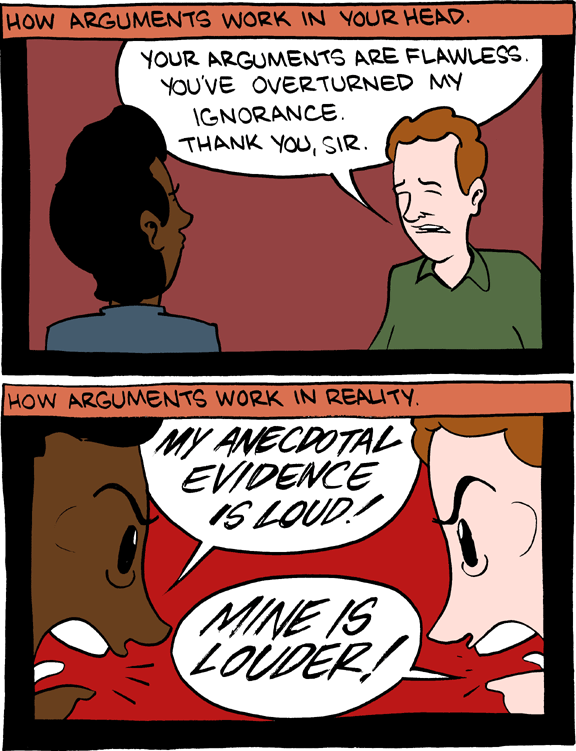
http://www.smbc-comics.com/
Hence all the hostility amongst religions, or competing scientific theories.
We should be, at the very least, polite in our arguments -- and always have good, solid supporting evidence.
For politeness: How to Argue on the Internet and Linguistic Politeness Research Group
For good, solid arguments :
http://www.smbc-comics.com/
Tuesday, June 28, 2011
Why External Evaluation Really Helps
GrrlScientist often posts amazing stuff. Today was no exception.
I've been angsting over my comparative writing ability. I know - really stupid. After a certain technical competence is achieved, and a certain facility with words and style, it is so subjective.
But - this fascinated me. How do we assess ourselves, and others? How accurate are we in those assessments?
Interestingly, the less competent you are, the better you seem to think yourself. Competent people tend to over-rate others' performances, thus lessening their self-perceived skills.
Heartening conclusion: training and education - objective skills, do make us better at these judgements.
illusion of superiority
I've been angsting over my comparative writing ability. I know - really stupid. After a certain technical competence is achieved, and a certain facility with words and style, it is so subjective.
But - this fascinated me. How do we assess ourselves, and others? How accurate are we in those assessments?
Interestingly, the less competent you are, the better you seem to think yourself. Competent people tend to over-rate others' performances, thus lessening their self-perceived skills.
Heartening conclusion: training and education - objective skills, do make us better at these judgements.
illusion of superiority
Wednesday, June 22, 2011
Cracked, and Writing is Despair - when it's not elation
I was doing my morning's routine of reading comics, then blogs. Science, philosophy; and there's a few writing ones I like to follow. Though for writing I mostly use Twitter - a random idea jumps out and says "Here! This is what you've been needing to think about!" For which I am truly, truly grateful.
Anyways, on one of the philosophy blogs I followed a link and discovered that the book I've been working one for the last year is, apparently, a cheap flimsy watered-down version of the sort of novels some very famous (in the right circles) (which I obviously don't inhabit) (which is another point of despair) person has been writing for many years now.
All my hundreds of hours of research, my hundreds of hours of writing, my in progress hundreds of hours of editing - for what?
And I am sunk once again in inescapable gloom.
What's the point? I know I am not unique, that no one is unique, that every story has been told thousands of thousand of times... but I was feeling pretty good about my book up to that moment.
I used to be a very stable person. Not without upheavals, but generally rational, reasonable, and not prone to gloom.
Since becoming a writer, my life is the proverbial roller-coaster. And not with slow steady swings from elation to despair.
Oh no. That would be too easy. Like a toddler with a light switch my brain leaps from extreme to extreme, within the same bleeding sentence.
So then I find this: http://www.cracked.com/blog/how-to-become-author-in-5-incredibly-difficult-steps/
I don't know how I hadn't seen it before. Cracked is a wonderful place for researched information in a quirky, irreverent style.
Being able to laugh, even though being reminded yet again (and I didn't need the reminder - I never forget) that I am not in the tiniest bit unique, made me feel better.
And I will write today. How could I not? It is who I am, for good or ill.
Anyways, on one of the philosophy blogs I followed a link and discovered that the book I've been working one for the last year is, apparently, a cheap flimsy watered-down version of the sort of novels some very famous (in the right circles) (which I obviously don't inhabit) (which is another point of despair) person has been writing for many years now.
All my hundreds of hours of research, my hundreds of hours of writing, my in progress hundreds of hours of editing - for what?
And I am sunk once again in inescapable gloom.
What's the point? I know I am not unique, that no one is unique, that every story has been told thousands of thousand of times... but I was feeling pretty good about my book up to that moment.
I used to be a very stable person. Not without upheavals, but generally rational, reasonable, and not prone to gloom.
Since becoming a writer, my life is the proverbial roller-coaster. And not with slow steady swings from elation to despair.
Oh no. That would be too easy. Like a toddler with a light switch my brain leaps from extreme to extreme, within the same bleeding sentence.
So then I find this: http://www.cracked.com/blog/how-to-become-author-in-5-incredibly-difficult-steps/
I don't know how I hadn't seen it before. Cracked is a wonderful place for researched information in a quirky, irreverent style.
Being able to laugh, even though being reminded yet again (and I didn't need the reminder - I never forget) that I am not in the tiniest bit unique, made me feel better.
And I will write today. How could I not? It is who I am, for good or ill.
Thursday, June 2, 2011
Science and Uncertainty
Four posts today, all on the topics of what we think we know, what we actually do know, and how we go about distinguishing between the two. And having distinguished, what do we do about it?
First up, recognizing that uncertainty is not an excuse for ignoring probable danger. The context here is global climate change. There is enough evidence to know that the climate is warming. Even if it were entirely natural, we still need to be working hard on ways to minimize the disruption (gentle word) climate shift will cause. And yet the reaction is all too often complete denial (humorous take on argumentative reasoning here) or accepting it's happening, but not that it will cause problems. Neither response will help. Hence the phrase in Professor Juan Cole's post: "The Big Oil and Big Coal executives attempting to stop efforts to reduce emissions are thus in effect mass murderers of a future generation."
Read also Chris Mooney on uncertainty as a response.
Then there was a delightful post about established beliefs in science. Eventually testing wins over belief. That's why science improves the way we live and belief can't. Without science, we'd all be living in caves eating raw food and dying of simple injuries and diseases. But we'd have our beliefs! Such a comfort. The first hand account by Mpemba is a joy to read. And I loved footnote six. Finding observational information in all sorts of strange places.
Last is a distressing post about how we alter our own behavior to fit perceived stereotypes about ourselves. Apparently the ruling bodies of the Educational Testing Services want to keep women and minorities out of higher education? (don't sue me - change your testing!)
First up, recognizing that uncertainty is not an excuse for ignoring probable danger. The context here is global climate change. There is enough evidence to know that the climate is warming. Even if it were entirely natural, we still need to be working hard on ways to minimize the disruption (gentle word) climate shift will cause. And yet the reaction is all too often complete denial (humorous take on argumentative reasoning here) or accepting it's happening, but not that it will cause problems. Neither response will help. Hence the phrase in Professor Juan Cole's post: "The Big Oil and Big Coal executives attempting to stop efforts to reduce emissions are thus in effect mass murderers of a future generation."
Read also Chris Mooney on uncertainty as a response.
Then there was a delightful post about established beliefs in science. Eventually testing wins over belief. That's why science improves the way we live and belief can't. Without science, we'd all be living in caves eating raw food and dying of simple injuries and diseases. But we'd have our beliefs! Such a comfort. The first hand account by Mpemba is a joy to read. And I loved footnote six. Finding observational information in all sorts of strange places.
Last is a distressing post about how we alter our own behavior to fit perceived stereotypes about ourselves. Apparently the ruling bodies of the Educational Testing Services want to keep women and minorities out of higher education? (don't sue me - change your testing!)
Subscribe to:
Posts (Atom)