
Showing posts with label Editing. Show all posts
Showing posts with label Editing. Show all posts
Thursday, November 10, 2011

Thursday, September 15, 2011
An Editor's Demonstration
I know how this feels. Okay, not completely rewritten, but it sure felt like that at first glance. Here's to hoping the next draft will have fewer crossings-out!
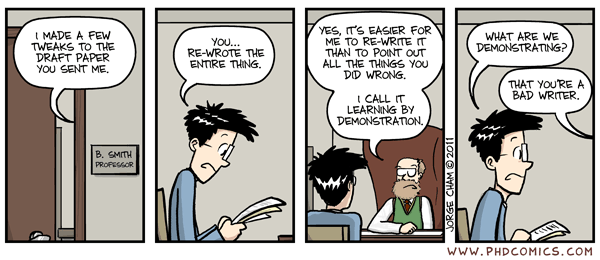 http://www.phdcomics.com/comics/archive/phd091411s.gif
Tuesday, August 23, 2011
Self-Deception
One of the themes that always pokes its way into my stories is integrity. Not being who you think you should be, or who you think others want you to be, but rather, finding who you truly are.
Facing facts is a tangent of that. And yet, self-delusion can be helpful. It gets us through times of hardship. "This, too, shall pass." "It's always darkest just before dawn," "Light at the end of the tunnel." Myriad proverbs to choose from, all telling us that we needn't give up hope, needn't face facts. Instead, we can adapt reality to make us comfortable.
So, we have to find a balance between accepting reality clearly enough that we can deal with life as it is, but not so bluntly that we become despairing or incapable of action.
My re-interpretation of reality was that I could write a novel in a month, including at least one thorough round of editing and revision, and then publish it as an ebook. I cheerfully announced that I would let it go, knowing it wouldn't be a good as it could be, because I need the satisfaction of having something 'finished' and out-there. Also, I need to learn how to get ebooks formatted for the various distribution sites.
My learning novel, I called it.
And now I find I cannot do it. Oh, I can have it written. I can revise it, too; I already am. I find I cannot write the outline that will facilitate said revisions without stopping to implement them. No self-restraint, alas. So I will meet those goals.
But -- I cannot put a book out into the world unless I make it something I'm proud of. So now I see myself with not just two novels in editing, but three.
I have to get back to Adjacent Possibilities. I've learned so much from the Sooty Experiment, and the editing will go more easily because of that. But I did so want to believe I could relax and accept an adequate novel, just for the sense of accomplishment in saying: I have a story available.
I'll keep to my month. I'll get Sooty written. I've already spoken to an editor, too, to provide that so-necessary extra pair of eyes. I'll get Sooty shaped up to where I can let it try its proverbial wings. I cannot say when, but I'm now hoping by mid-October. Still very fast, I know. But I'm trying to find that precarious balance between the sense of completion I need and the sense of pride I have to have in my work.
( Update: I should clarify. I normally do not write so swiftly. For the other two novels-in-editing, one is going on for almost 2 years, the other, Adjacent Possibilities, for just over a year. Both are still being researched as well as edited and revised, and for both I sometimes wonder how one ever knows when something is finished. All I know is that neither of them is finished, nor will be for many months, perhaps years to come. )
Word counts are not totally abandoned, but I'm letting them slide until I get the outline done. Then I'll get the middle written, and have a completed first draft to announce.
Facing facts is a tangent of that. And yet, self-delusion can be helpful. It gets us through times of hardship. "This, too, shall pass." "It's always darkest just before dawn," "Light at the end of the tunnel." Myriad proverbs to choose from, all telling us that we needn't give up hope, needn't face facts. Instead, we can adapt reality to make us comfortable.
So, we have to find a balance between accepting reality clearly enough that we can deal with life as it is, but not so bluntly that we become despairing or incapable of action.
My re-interpretation of reality was that I could write a novel in a month, including at least one thorough round of editing and revision, and then publish it as an ebook. I cheerfully announced that I would let it go, knowing it wouldn't be a good as it could be, because I need the satisfaction of having something 'finished' and out-there. Also, I need to learn how to get ebooks formatted for the various distribution sites.
My learning novel, I called it.
And now I find I cannot do it. Oh, I can have it written. I can revise it, too; I already am. I find I cannot write the outline that will facilitate said revisions without stopping to implement them. No self-restraint, alas. So I will meet those goals.
But -- I cannot put a book out into the world unless I make it something I'm proud of. So now I see myself with not just two novels in editing, but three.
I have to get back to Adjacent Possibilities. I've learned so much from the Sooty Experiment, and the editing will go more easily because of that. But I did so want to believe I could relax and accept an adequate novel, just for the sense of accomplishment in saying: I have a story available.
I'll keep to my month. I'll get Sooty written. I've already spoken to an editor, too, to provide that so-necessary extra pair of eyes. I'll get Sooty shaped up to where I can let it try its proverbial wings. I cannot say when, but I'm now hoping by mid-October. Still very fast, I know. But I'm trying to find that precarious balance between the sense of completion I need and the sense of pride I have to have in my work.
( Update: I should clarify. I normally do not write so swiftly. For the other two novels-in-editing, one is going on for almost 2 years, the other, Adjacent Possibilities, for just over a year. Both are still being researched as well as edited and revised, and for both I sometimes wonder how one ever knows when something is finished. All I know is that neither of them is finished, nor will be for many months, perhaps years to come. )
Word counts are not totally abandoned, but I'm letting them slide until I get the outline done. Then I'll get the middle written, and have a completed first draft to announce.
Tuesday, August 16, 2011
Pronouns and Word Choice Reveal Gender, Rank, and Intelligence
One reads posts analyzing how to write a male character, or how to write a female character. I often find myself irritated -- women have to have lots of friends, they have to be emotional, they have to care about dressing up, and they have to think men are uncommunicative. Men have to be taciturn, talk about football, have only one or two close friends (to whom they speak in occasional grunts), and they have to think women are irrational.
In reality, some women are sports-mad and some like fluffy little dogs. Some men are sharp dressers and some like fishing alone for hours.
But this article from Scientific American has real advice on writing relationships. Chose your pronouns carefully, writers. They can reflect gender, social rank, and intelligence.
Although we never notice it, when analyzed our speech patterns and writing show that women are far more likely than men to use cognitive words (e.g., because, reason, think, believe); social words (e.g., he, she, friend, cousin); and 1st person singular (I, me, my).
Men use articles more than women: (a, an, the).
According to Psychologist James Pennebaker, "men and women use language differently because they negotiate their worlds differently. Across dozens and dozens of studies, women tend to talk more about other human beings. Men, on the other hand, are more interested in concrete objects and things. To talk about human relationships requires social and cognitive words. To talk about concrete objects, you need concrete nouns which typically demand the use of articles."
Also, people of lower rank use "I" words in communications, whereas higher rank people avoid them.
These offer new ways to look at characterization. Although in reality we are unaware of these cues, if we write them into our characters, mightn't it make the reader's perception of their roles more vivid?
It's not just gender. This fascinated me:
"Higher GPAs were associated with admission essays that used high rates of nouns and low rates of verbs and pronouns. The effects were surprisingly strong and lasted across all years of college, no matter what the students’ major.
To me, the use of nouns -- especially concrete nouns -- reflects people’s attempts to categorize and name objects, events, and ideas in their worlds. The use of verbs and pronouns typically occur when people tell stories. Universities clearly reward categorizers rather than story tellers. If true, can we train young students to categorize more? Alternatively, are we relying too much on categorization strategies in American education?"
As I growled about a few posts back, writers can be seen by more analytic minds as being of inferior intelligence -- something that also plagues women in the eyes of some men. Emotional, social, story-telling minds are less valued than analytic, concrete minds.
Why?
I would argue both are important, and are equally essential to our human existence. Without the story tellers and the emotion-givers, we are robots. Without analysis and concrete reality, we are adrift without reason.
I am intrigued, and anxious to try gender-pronouns and concrete versus emotional in my stories.
How do you write? How do you tell a story that reflects the concrete? Do you have special cues you use for gender and rank? I'd love to read about them.
In reality, some women are sports-mad and some like fluffy little dogs. Some men are sharp dressers and some like fishing alone for hours.
But this article from Scientific American has real advice on writing relationships. Chose your pronouns carefully, writers. They can reflect gender, social rank, and intelligence.
Although we never notice it, when analyzed our speech patterns and writing show that women are far more likely than men to use cognitive words (e.g., because, reason, think, believe); social words (e.g., he, she, friend, cousin); and 1st person singular (I, me, my).
Men use articles more than women: (a, an, the).
According to Psychologist James Pennebaker, "men and women use language differently because they negotiate their worlds differently. Across dozens and dozens of studies, women tend to talk more about other human beings. Men, on the other hand, are more interested in concrete objects and things. To talk about human relationships requires social and cognitive words. To talk about concrete objects, you need concrete nouns which typically demand the use of articles."
Also, people of lower rank use "I" words in communications, whereas higher rank people avoid them.
These offer new ways to look at characterization. Although in reality we are unaware of these cues, if we write them into our characters, mightn't it make the reader's perception of their roles more vivid?
It's not just gender. This fascinated me:
"Higher GPAs were associated with admission essays that used high rates of nouns and low rates of verbs and pronouns. The effects were surprisingly strong and lasted across all years of college, no matter what the students’ major.
To me, the use of nouns -- especially concrete nouns -- reflects people’s attempts to categorize and name objects, events, and ideas in their worlds. The use of verbs and pronouns typically occur when people tell stories. Universities clearly reward categorizers rather than story tellers. If true, can we train young students to categorize more? Alternatively, are we relying too much on categorization strategies in American education?"
As I growled about a few posts back, writers can be seen by more analytic minds as being of inferior intelligence -- something that also plagues women in the eyes of some men. Emotional, social, story-telling minds are less valued than analytic, concrete minds.
Why?
I would argue both are important, and are equally essential to our human existence. Without the story tellers and the emotion-givers, we are robots. Without analysis and concrete reality, we are adrift without reason.
I am intrigued, and anxious to try gender-pronouns and concrete versus emotional in my stories.
How do you write? How do you tell a story that reflects the concrete? Do you have special cues you use for gender and rank? I'd love to read about them.
Monday, August 8, 2011
Writing in Reverse, and How On Earth Does One Self-Edit, Or Self-Evaluate?
I'm quite enjoying writing backwards. I ask myself, where do I want this character to be at the end of the story, and then I write. I refer to things that will need to be added or explained earlier in the story.
Then I ask, how did they get from the beginning to where they are now? What had to happen for the ending to happen as written? Add in the points I mentioned above, and a scene in front of the one I just wrote takes shape. Step by reverse step, I'm finding out where the story is coming from, rather than where it's going.
I may not get anything written tonight. Busy, busy, unfortunately. But I did jot down some ideas, and I got a section of the story worked up for my critique group.
I had another melt down last evening. I looked at my writing and thought, "This is crap. Total, incontrovertible crap."
Then I started writing, forgot about crappiness, and just enjoyed the story.
I keep wondering about my desire for external validation. There is a notable agent that is accepting the first 20 pages from ten local authors for her critique. Even if it weren't out of my budget, I wonder if I would do that. If she said it was no good, I wouldn't stop writing. If she said it was good, I still wouldn't stop. So, why seek opinions?
Obviously because I have no confidence in my own abilities. How does one acquire that objectiveness? All I read (and I read so very much) about self-editing seems inevitably to rely upon one's own discernment of what 'feels' right.
All I know is that when my editor has returned pages to me with lots of green crossings-out, I cannot understand why this was cut and not that, or why this emotional depiction was deemed unacceptable but this other was okay. I remain perplexed.
He tells me I should write more, and thus learn. Well, huh. I wonder how much writing it will take for me to feel confident in what I create?
Do all you other writers get hung up on this? Do you feel you know when you've gotten it right? Do you angst over understanding, or just enjoy the writing and accept the editing?
Then I ask, how did they get from the beginning to where they are now? What had to happen for the ending to happen as written? Add in the points I mentioned above, and a scene in front of the one I just wrote takes shape. Step by reverse step, I'm finding out where the story is coming from, rather than where it's going.
I may not get anything written tonight. Busy, busy, unfortunately. But I did jot down some ideas, and I got a section of the story worked up for my critique group.
I had another melt down last evening. I looked at my writing and thought, "This is crap. Total, incontrovertible crap."
Then I started writing, forgot about crappiness, and just enjoyed the story.
I keep wondering about my desire for external validation. There is a notable agent that is accepting the first 20 pages from ten local authors for her critique. Even if it weren't out of my budget, I wonder if I would do that. If she said it was no good, I wouldn't stop writing. If she said it was good, I still wouldn't stop. So, why seek opinions?
Obviously because I have no confidence in my own abilities. How does one acquire that objectiveness? All I read (and I read so very much) about self-editing seems inevitably to rely upon one's own discernment of what 'feels' right.
All I know is that when my editor has returned pages to me with lots of green crossings-out, I cannot understand why this was cut and not that, or why this emotional depiction was deemed unacceptable but this other was okay. I remain perplexed.
He tells me I should write more, and thus learn. Well, huh. I wonder how much writing it will take for me to feel confident in what I create?
Do all you other writers get hung up on this? Do you feel you know when you've gotten it right? Do you angst over understanding, or just enjoy the writing and accept the editing?
Subscribe to:
Posts (Atom)